



Othering (from the English word other — “different” or “another”) is the process of psychologically or socially separating and opposing “us” and “them.” It occurs when a group or individual is perceived as foreign, different, abnormal, or “other” and, as a result, as less important, unequal, or sometimes even dangerous.
In Russian, there is still no single established equivalent for the term othering, but the following options are most commonly used:
- Stigmatization — emphasizes the assignment of negative labels.
- Enemy image — when the discussion concerns politics or conflict.
- Process of alienation — emphasizes social separation.
- Marking someone as “other” — the closest literal rendering.
- Exclusion of “outsiders” — an option used in social and ethnocultural contexts.
- Drugovanie (a neologism) — a Russian term sometimes encountered in academic circles and blogs as an attempt to create a precise equivalent of the English word.
Othering is often accompanied by:
- Stereotyping, when generalized negative traits are attributed to a group (for example, “they are lazy,” “they are aggressive”).
- Blaming, when the explanation becomes “it is all because of them.”
- Isolation or alienation from the main group.
- Reduced empathy toward “others.”
For example, during crises, disasters, or conflicts, people often feel the urge to find someone to blame — and the blame falls not on “us,” but on some “them”: immigrants, another political party, neighbors, religious minorities, and so on. It is also important to understand that othering can occur at both the individual and collective level.
The “Us vs. Them” Mechanism
Othering begins with a simple contrast: “we are normal — they are strange.” In everyday life this may be barely noticeable: we tend to trust “our own” more and become automatically wary when we encounter “outsiders.” In other words, it is a natural cognitive tendency in which a person divides the world into two groups:
- “Us” — our own group, safe, understandable, “normal.”
- “Them” — outsiders, unfamiliar, potentially dangerous.
 In prehistoric tribes, outsiders could represent a real threat — they might carry diseases, compete for resources, or attack. Fast recognition of “our own” and “outsiders” therefore became a survival mechanism. The primitive brain reacted according to a simple rule: “unfamiliar → may be dangerous.” This distinction helps people make quick decisions about who may be an ally and who may be a threat. But the same mechanism can also underlie prejudice, discrimination, and conflict.
How does this work? Information about people and situations is processed quickly and often unconsciously, including cues such as appearance, speech, smell, and behavior. This is connected with the need for affiliation — the desire to belong to a group. At the same time, an “outsider” may trigger a biological stress or rejection response (stress, tension).
Human history is, to a considerable extent, a history of violence and wars. Since ancient times, tribes have fought one another — “our own” were regarded as people, while “outsiders” were called barbarians. Among the ancient Greeks, the word “βάρβαρος” (barbarian) referred to those who did not speak Greek — people who were “not like us.”
In the Middle Ages, Christian Europe often viewed Muslims, Jews, and pagans as “impure” and “alien.” The Inquisition and the Crusades were also fueled by ideas of struggle against “others.”
In the modern era, colonialism was built in part on the contrast between the “civilized West” and “savages.” The enslavement and subjugation of colonized peoples were justified through divisions between “people” and “almost people.”
The 20th century brought its own forms of this process. Nazi Germany built a genocidal policy around ideas of “Aryan purity” and struggle against those defined as “racially alien.” In the Soviet Union, the category of “enemies of the people” was used to mark “outsiders” within the country.
Today, the “us versus them” mechanism can appear in politics (left/right), national and migration conflicts (migrants/locals), information warfare (my truth/the other side’s fake news), the Internet (toxic discussions, cancel culture), and even in sports — in fan movements (our supporters/the rival club).
Why is it important to recognize this? Because in modern society this ancient mechanism often interferes with dialogue, integration, and mutual understanding. It creates false oppositions and simplified but distorted pictures of the world. By noticing it in ourselves, we gain a chance to:
- expand the boundaries of empathy,
- begin a dialogue with “others,”
- strengthen our sense of internal and external security.
Othering as a Defense Against Anxiety
When crises occur — economic, political, or personal — anxiety rises. It is easier to explain what is happening by finding an external “culprit.” When a person is frightened, confused, or in pain, the mind looks for quick explanations and simple ways out. Othering can become one such reaction: we project our internal anxiety outward and find “culprits” who supposedly cause it. This is how convenient myths arise: “It is all because of migrants,” “These people are destroying our traditions.”
Anxiety is a signal of uncertainty, danger, or loss of control. It may be rational (a real fear for health, finances, and so on) or irrational (a sense of uncertainty without a clear cause). If anxiety does not find an outlet or an explanation, it may continue to build internally. The psyche then turns to defense mechanisms — psychological ways of coping with tension. One of them can be projection + alienation: “It is not my fault. They are to blame. They frighten me. They are stopping me from living.”

How does this mechanism work? Anxiety arises from stress, social instability, and uncertainty. A person accumulates feelings of helplessness, guilt, fear, or shame. The psyche looks for a way to “clear” itself and transfers these feelings onto an external group. The idea develops: “if it were not for them, everything would be fine.” This creates an illusion of control and clarity: there is a concrete cause of the problems, and it can supposedly be removed.
Why can this feel helpful, even if only temporarily? It reduces internal tension. A person can now experience themselves as a victim of external forces rather than confronting their own choices. It creates a sense of order. The world becomes understandable again: “we are good, they are bad.” In addition, it unites “our own.” A common “enemy” can make unity easier to feel.
But all of this is an illusion of safety that can lead to new conflicts.
Examples from Everyday Life
1. At home:
A mother says: “My son gets bad grades because the teacher picks on him.” This may feel easier than admitting that the son is not studying or that the mother herself is overwhelmed.
2. In society:
During the pandemic, myths appeared such as: “it is all because of tourists,” “because of certain nationalities,” or “because of the authorities.”
3. In politics:
Political leaders may use citizens’ anxiety and direct it toward people presented as “culprits”: migrants, the opposition, the West, the East — depending on the situation.
All of this can be highly dangerous because it:
- Maintains a false sense of control without solving real problems.
- Intensifies hatred, hostility, and segregation.
- Destroys dialogue — because “others” are no longer perceived as equals.
- Closes the path to personal responsibility and mature development.
Dehumanization: When “Others” Are No Longer Seen as People
Dehumanization is a process in which a person or group is no longer perceived as fully human individuals. Instead, they are reduced to images, labels, and symbols of threat. This is more than a negative attitude — it is a loss of recognition of another person’s humanity.
 This can happen in many different ways. For example, through stereotypes, when people are assigned generalized characteristics such as “aggressive,” “dirty,” “stupid,” or “a threat to society.” It can happen through language, when a category is used instead of a person’s identity: ethnic slurs, political insults, “old hags,” “bureaucrats,” “the crowd,” “they.” This simplification creates distance. It can also happen through repetition, when the same negative image is imposed again and again — in the media, conversations, memes — until it no longer feels distorted and starts to seem normal. Another form of dehumanization is comparison with the nonhuman, when people are called a “virus,” “insects,” “parasites,” “infected,” or “zombies” — language that can reduce empathy in the listener. After all, people do not feel much pity for a cockroach.
Dehumanization is not merely a theoretical threat; it can become a real path toward violence. In genocides of the 20th century (Rwanda, the Holocaust, Cambodia), victims were repeatedly described with terms such as “rats,” “cockroaches,” or “infection.” Such language helped make mass killing psychologically easier to justify. In war, the enemy may be described not as a soldier but as a “target,” an “object,” or a “terminal.” This can function as psychological distancing and at the same time as a mechanism that facilitates destruction. In everyday life, dehumanization can underlie bullying, discrimination, police violence, and segregation.
Nevertheless, we can try to notice and control these tendencies in ourselves, in particular through conscious work with perception:
- Notice the language you use and hear: where exactly does the “person” disappear?
- Ask yourself: if this were someone close to me, would I speak or think in the same way?
- Practice empathy. You do not have to agree with another person’s experience in order to try to understand it.
- Remember that every “other” person has a history, feelings, fears, and vulnerabilities — the same kinds of things you have.
Dehumanization does not usually happen all at once. It can accumulate gradually: from a seemingly harmless joke to violence. But the path is often the same: from “he/she” — to “it” — to “nothing”.
Othering in Language and the Media
Language is not merely a means of communication. It is a tool that shapes perception. When images of “others” as dangerous, inferior, or somehow “not real” become embedded in language, they become part of the way people think. Through the media, such language can spread and scale rapidly.
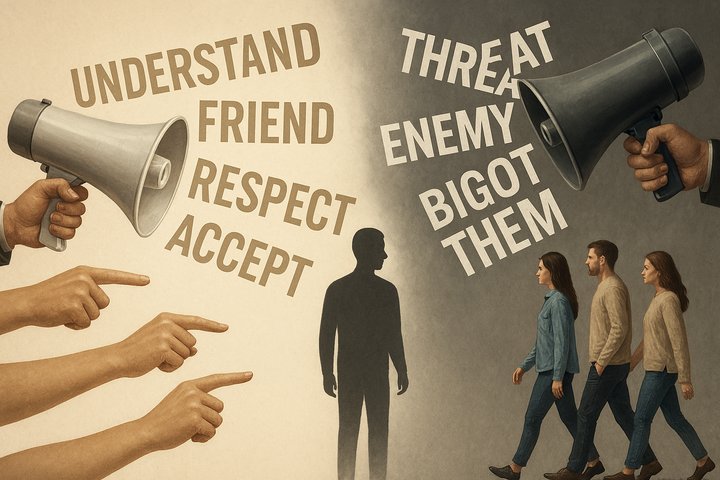 Today, many examples of this can be found:
1. Through stigmatizing labels
- “They” → not “people,” but “a mob,” “invaders,” “a threat.”
- Typical formulations:
— “These people do not want to work”
— “They have ruined everything again”
— “We do not need this”
— “We are not like them”
2. Through a simplified dichotomy
The world is divided into “good” and “evil,” “our own” and “outsiders.” Media framing may take forms such as:
- “Decent citizens versus an aggressive minority”
- “We are defending ourselves against them”
- “Our culture is in danger”
3. Through emotional triggers
Words are used that evoke fear, disgust, or aggression.
Examples:
- Instead of “refugees” — “a flood of migrants”
- Instead of “protesters” — “rioters,” “a mob”
4. Through the choice of visuals
- Photos in which members of a group look aggressive, unkempt, or threatening.
- Images without faces, which depersonalize people — for example, only hands, hoods, or silhouettes.
5. Through omission or one-sided presentation
- The voices of “others” are not represented.
- Context is missing.
- Only extreme, negative examples are shown.
All of this can be highly dangerous because it forms collective prejudices, while constant repetition of stereotypes can make them appear “self-evident” to many people. It can also support aggression; in conditions of anxiety and stress, society may be more easily mobilized against someone presented as an “enemy.” It can also become much easier to justify violence and discrimination if “they” are seen as not quite human and therefore supposedly deserving of different treatment. It also destroys dialogue when understanding is replaced by shouting and discussion by confrontation.
Countering this phenomenon requires critical thinking and a conscious approach to consuming information. At a personal level, you can:
- Develop media literacy. Learn to recognize emotional manipulation, labels, and one-sided presentation.
- Check facts. Use multiple sources, including sources that represent different viewpoints.
- Ask yourself questions:
— Who is speaking?
— Whose voices are missing?
— Why is this being shown to me in this particular way? - Support independent and responsible media.
At the societal level, it is important to promote respectful language in public discourse, oppose hate speech, and teach children to recognize manipulation and treat “others” as equals.
Media and language shape reality. The way we speak about other people influences whether we see them as people or as threats. Othering can be resisted — but only if we stop being passive consumers and become conscious readers.
How to Stop Othering Within Yourself
 Othering does not begin with other people. It begins with us. With the way we look, speak, and divide the world into those who are “close to us” and those who are “outsiders.” Stopping it therefore means doing inner work. And that can be very difficult:
- Because the mechanism is automatic.
The brain naturally looks for differences, labels, and patterns. Classification and threat prediction are built into the way we process information. - Because society reinforces it.
Language, media, jokes, and group loyalties can all push us toward division: “we” are good, “they” are not. - Because it is easier.
It is easier not to doubt. Easier not to investigate. Easier to attach a label and move on.
But can this be changed? Yes. But only through awareness and regular practice. Here are some concrete steps:
1. Notice your automatic reactions
When you think or say something like “they are all the same,” “a typical one of them,” “we do not need people like that” — stop for a moment. Ask yourself: what am I doing right now?
2. Separate the person from the image
When you hear or see someone who seems “foreign” or “irritating,” try asking yourself: who is this person, what have they experienced, and where might these views or behaviors come from? This is not an excuse. It is a broader context.
3. Seek personal contact
Get to know people who are different from you. Talk without making the goal to argue or persuade. Listen not in order to reply, but in order to understand. Even one genuine conversation can challenge dozens of stereotypes.
4. Watch your language
In conversation, replace “these people” → “some people,” “all of them” → “some of them,” “outsiders” → “others,” “problem” → “situation.” Language is a habit, and habits can be changed.
5. Accept the complexity of the world
The world is not divided into black and white. Nor do you have only one identity. You may be a son, citizen, neighbor, professional, pedestrian, customer, or viewer. Other people likewise have many roles, histories, fears, and hopes.
6. Do not try to be a “saint”
We are all prone to making divisions. This is not about guilt; it is about responsibility. The goal is not to “never make a mistake,” but to notice when you are taking an oversimplified path and return.
In short: what can you do right now?
- Start listening — genuinely.
- Replace labels with questions.
- Give up sweeping generalizations.
- Notice fear and shame — othering often grows around them.
- Talk respectfully with people you disagree with.
Stopping othering within yourself is not a one-time act. It is a long and difficult process. But along the way, you can learn not only about the complex and diverse world around you, but also about yourself.