



Public speaking is always a challenge, even for experienced speakers. It requires not only confidence, but also an understanding of audience psychology, ways to manage nervousness, and effective presentation of information.
Stage fright is an evolutionary mechanism. In ancient times, isolation from the group could lead to death, so fear of judgment was important for survival. Today, this fear appears as a fear of looking foolish (a cognitive factor), physiological reactions (sweating, rapid heartbeat, dry mouth), self-criticism, and perfectionism.
At the same time, public speaking is not an innate talent, but a skill that can be developed. Preparation, emotional regulation, and understanding the audience can make any speech more successful. The more experience you gain, the less fear you tend to feel!
Scientific Disciplines and Practical Approaches to Studying and Preparing for Public Speaking
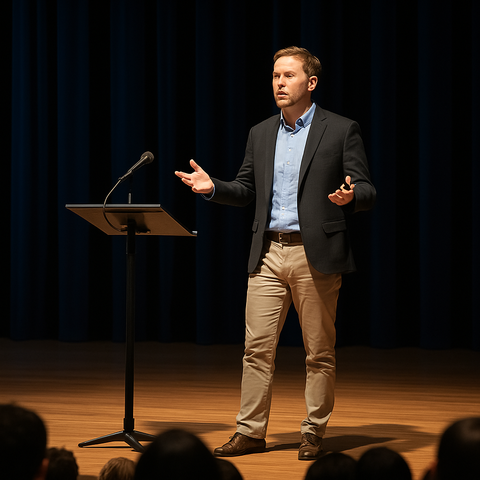 There is an entire intersection of scientific disciplines and practical approaches devoted to studying and preparing for public speaking. The main areas are:
Rhetoric and Oratory
Rhetoric is the ancient art and study of eloquence, dating back to ancient Greece and Rome (Aristotle, Cicero). Modern schools of rhetoric include:
- Structuring a speech;
- Argumentation and persuasion;
- Using body language and intonation.
Rhetoric is studied in philology and philosophy departments, public-speaking schools, TEDx programs, and Toastmasters.
Psychology of Communication
This is a branch of social psychology that studies:
- Interpersonal influence;
- Audience perception;
- Managing nervousness and stage fright;
- Nonverbal behavior.
It is studied in psychology departments, communication training programs, and fields such as “psychology of influence” and “psychology of persuasion.”
Acting and Stage Speech
Theater training provides a strong foundation in:
- Working with voice, breathing, and the body;
- Emotional expressiveness;
- Overcoming shyness in front of an audience.
These skills are taught at theater schools and studios; for example, courses in “stage speech” are even available to nonprofessionals at some universities.
PR and Public Communication
This includes:
- Working with the media, interviews, and presentations;
- Crisis communication;
- Image and reputation.
These topics are studied in PR and marketing programs and in business schools (MBA and executive education).
Specialized Training and Coaching
There is an entire industry of courses on TED-style talks, storytelling, business presentation skills (for example, for startups or managers), and speaker clubs such as Toastmasters International (a very effective way to practice in English).
Greatest Orators of the Past
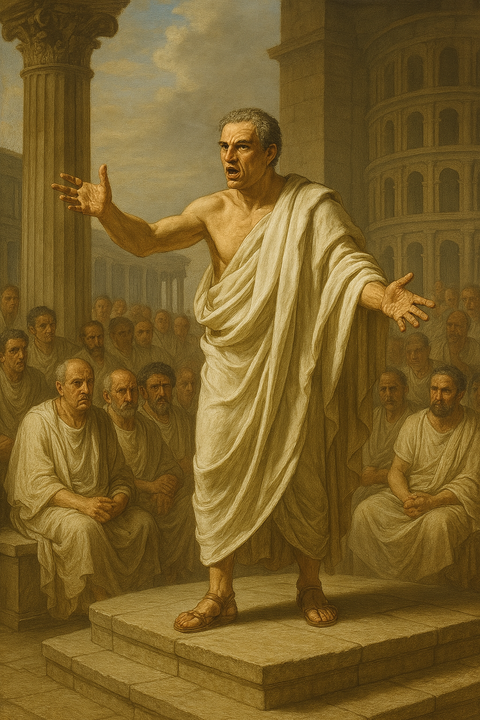 The great orators of the past did more than hold attention — they inspired nations, changed the course of history, and sometimes influenced the fate of empires with a single speech. Here are some of the most legendary:
Demosthenes (384–322 BC, Ancient Greece)
Demosthenes is famous for the fact that he trained himself to speak with pebbles in his mouth and against the wind to overcome a speech impediment. His speeches against Philip of Macedon, the “Philippics,” became a symbol of resistance. He could stir the Athenian crowd even when everything seemed to be against him. It is said that after one of his speeches, the people immediately decided to go to war.
Imagine a crowd in the square. Demosthenes steps onto the platform and thunders:
“And you sleep, citizens! Philip is no longer merely at the gates — he is already inside.
Do not wait for orders — take your shield, take your spear, and stand up for freedom!
Better to die standing than live on your knees before the Macedonian!”
At the heart of Demosthenes’ speeches were challenge and emotional momentum, leading listeners toward direct mobilization and concrete action.
Cicero (106–43 BC, Ancient Rome)
Cicero was a genius of logic, style, and sarcasm. He was a master of the “anatomy of argument” and political eloquence.
His speeches against Catiline became classics of the genre. The Senate. Everyone is tense. Cicero looks the conspirator in the eye: “Quo usque tandem abutere, Catilina, patientia nostra? ...” — “How long, Catiline, will you abuse our patience?. The Senate is silent, the people are afraid, and only you, conspirator, dare sit among us! Your crimes are known, your plans are exposed. Leave — before it is too late!”
Cicero’s strength lay in logic, drama, and personal attack. His speeches are still studied in rhetoric classes today!
Socrates (469–399 BC)
Socrates is famous for not writing speeches, yet speaking in such a way that his interlocutors arrived at the truth themselves. His dialogues with people in the squares of Athens are an example of gentle but powerful influence through questions. He is known to have inspired Plato and, through him, the whole of Western philosophy.
John Chrysostom (347–407 AD, Byzantium)
The name John Chrysostom means “golden-mouthed” — such was the beauty and power of his preaching. He combined theology, drama, and personal force of persuasion. His sermons were so popular that churches were packed.
Imagine a church full of people, candles flickering. The sermon sounds like music! “The word of God is a lamp in darkness, fire in the cold, and bread in hunger. Gold will not save you, but mercy will. Not glory, but love. Listen not with your ears, but with your heart — for only it knows the truth!”
John Chrysostom’s strength lay in metaphor, rhythm, and emotional penetration!
Abraham Lincoln (1809–1865)
Abraham Lincoln is famous, for example, for the fact that his “Gettysburg Address” lasted only about two minutes, yet entered history. Simplicity, strength, and humanity were the main features of his style.
Imagine the scene: the fields of Gettysburg, rows of graves. The president steps forward for just a couple of minutes: “The world will not remember what we said here. But it will never forget what they did here. Our task is to continue the great work for which they gave their lives. So that government of the people, chosen by the people and for the people, shall not disappear from the face of the Earth.”
Abraham Lincoln’s strength lay in brevity, humanity, and universality!
Winston Churchill (1874–1965)
Winston Churchill was a symbol of strength and resilience during the Second World War. His voice on the radio gave hope to millions.
Outside, it is the dark year of 1940. A radio, the hiss of static, and suddenly his voice: “We shall fight on the beaches. We shall fight in the fields and in the streets. We shall never surrender!”
Winston Churchill’s strength lay in repetition, firmness, and a drumlike rhythm!
Martin Luther King Jr. (1929–1968)
“I have a dream...” — this is the speech by Martin Luther King Jr. that changed attitudes toward racial discrimination. He made extensive use of biblical rhythm, repetition, metaphor, and passion.
Imagine Washington, with hundreds of thousands of people gathered around. The speaker talks, and it is as if the whole nation is listening in a single breath: “I have a dream — that one day my children will live in a country
where they will be judged not by the color of their skin, but by the content of their character. I have a dream today!”
Martin Luther King Jr.’s strength lay in repetition, imagery, and inspiration!
Psychological Recommendations
To cope with fear and other difficulties associated with public speaking, the following often help:
- Prepare thoroughly for the speech and know the subject well, so that confidence can displace anxiety.
- Practice key points in front of a mirror or record yourself on video.
- Use breathing techniques: inhale deeply for 4 seconds, hold for 4 seconds, exhale for 6 seconds.
- Shift the focus from “what will they think of me?” to “how can I be useful?”
- and so on.
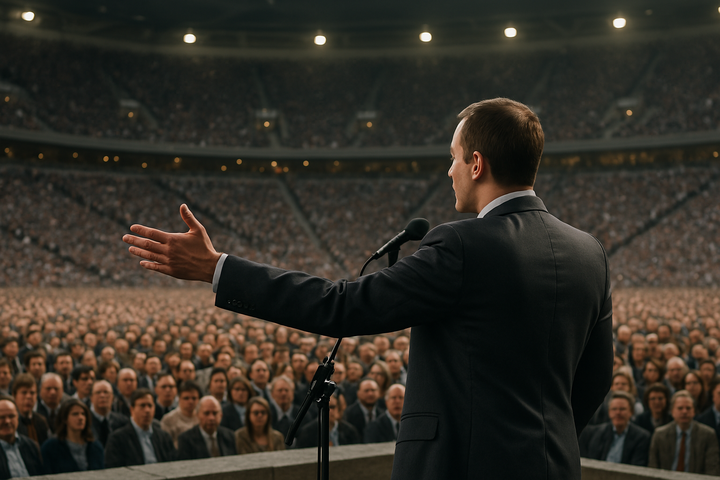
It is also important to understand audience psychology and how to hold attention. People absorb information better when the following principles are observed:
The first-seconds principle — begin with something engaging: a story, a question, or a paradox. The audience decides within 10–15 seconds whether it is worth continuing to listen.
Emotion and variation — vary intonation, rhythm, and volume. A monotonous delivery makes people tune out.
Body language — confident gestures, an open posture, and eye contact with the audience.
Structure — follow a clear logic: introduction → main part → conclusion. Use the “rule of three” (3 key ideas, 3 arguments).
Simplicity — avoid complex wording and terminology if the audience is not made up of experts.
Sometimes it helps to work through difficult moments in advance or use specific techniques during the speech. For example, if you have memory lapses, use cue cards with key points or memorize key phrases. In the case of difficult questions from the audience, thank the person for the question, pause to think about the answer, or admit that the information needs to be checked. When facing criticism and negativity do not enter into confrontation; instead, rephrase the negative question constructively and answer calmly.
Practice is the key to mastery! The most effective way to overcome fear is to speak more often. Start small: tell a story to friends, record a video, practice in a safe environment. And even when you become an experienced speaker, continue to follow these preparation steps:
- Analyze the target audience
- Prepare a written script, but do not memorize it word for word
- Rehearse while recording yourself on video
- Work on voice and speech: diction, pauses
- Get feedback from colleagues or a coach
- Run small tests by speaking to small groups