



Rumination is the repetitive dwelling on the same thoughts, usually negative ones. A person keeps replaying past mistakes, worrying about possible scenarios or focusing on personal flaws, but instead of finding a real solution, becomes stuck in the same mental loop.
This often occurs with anxiety, depression, and stress. Unlike productive reflection, rumination does not lead to useful conclusions and may only worsen a person’s emotional state.
If you find yourself caught in this pattern, you can try shifting your attention through exercise or hobbies, practicing mindfulness, or writing your thoughts down to see more clearly when they are going nowhere. Rumination is not a weakness or a “bad habit,” but a psychological mechanism that can be brought under greater control. A combination of mindfulness, action, and support can help break the cycle of repetitive thoughts and restore a sense of engagement with life.
What Is Rumination and Why Does It Matter?
 Rumination is the tendency to return again and again to the same thoughts, usually negative ones. A person may mentally “chew over” past events, mistakes, resentments, missed opportunities, or worries about the future without finding relief or a solution.
It may sound like this:
- “Why did I do that back then?”
- “What if I mess up again?”
- “People don’t respect me, and they probably never will...”
It is important to understand that thinking things over is normal and can even be useful. But rumination is a dead end: thoughts go in circles without progress. This is exhausting, increases anxiety, interferes with concentration, and makes it harder to enjoy life.
Why does this matter? Because rumination can feel like productive thinking even though it is not. People often fail to notice how long they have been stuck in this state. Persistent rumination, meanwhile, is associated with:
- depression,
- anxiety disorders,
- insomnia,
- poorer memory and concentration,
- a lower overall quality of life.
Awareness is the first step. If you recognize yourself or someone close to you in this description, that is already a reason to pay attention and take action.
How Rumination Develops and Why It Can Be Harmful
Rumination does not arise out of nowhere — it develops through a combination of personality traits, life experience, and cognitive patterns. The main factors that may contribute to rumination include:
- Anxiety and perfectionism. People with high levels of anxiety and perfectionists often try to anticipate everything, avoid mistakes, and mentally replay possible scenarios again and again. Perfectionists may endlessly analyze the past, trying to work out how they could have done things “perfectly.”
- Lack of emotional regulation skills. Some people find it difficult to recognize and process emotions, so instead they become mentally stuck in them.
- Unexpressed feelings. Suppressed resentment, anger, or shame often becomes “fuel” for internal monologues.
- Cognitive distortions. A tendency toward catastrophizing, black-and-white thinking, and overgeneralization can intensify rumination.
What happens in the mind of someone who ruminates? The brain strives for control and closure. When a situation feels unresolved or emotionally charged, the mind tries to “think it through” to a logical conclusion. But often there is no clear conclusion — and an endless cycle develops.
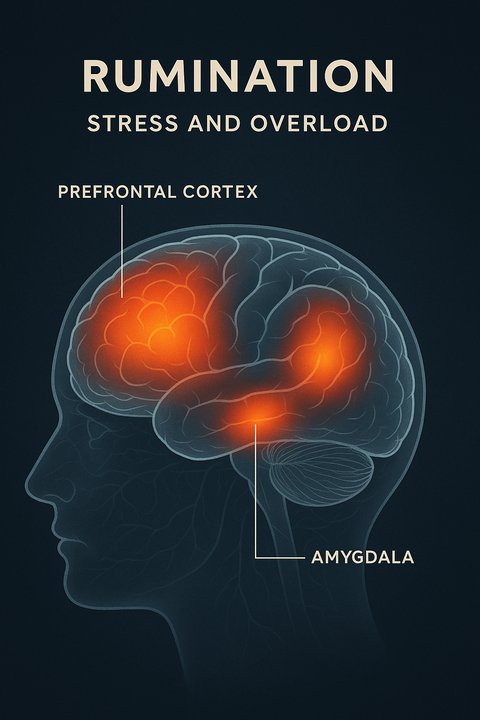 What does rumination look like in the brain? The prefrontal cortex, especially its medial regions is a “center of thinking,” logic, and self-reflection. During rumination it is hyperactive, particularly the medial areas involved in self-focused attention and inner monologue (“me,” “my mistakes,” “my feelings”). Instead of solving the problem, the brain becomes stuck: the same chains of thought are activated again and again.
The amygdala is a center of emotional responding, especially fear and anxiety. During rumination, the amygdala intensifies the anxious background — the brain interprets negative thoughts as a potential threat and activates the stress response.
The anterior cingulate cortex is involved in emotion regulation and error detection. During rumination it may become overloaded — a person feels that something is wrong but cannot stop the internal dialogue.
As a result, instead of adaptive analysis we get unproductive mental activity, elevated cortisol levels, and general tension. Resources are spent not on action but on internal “mental chewing.”
Rumination may seem like a harmless habit, but in practice it:
- worsens stress by maintaining high cortisol levels;
- interferes with sleep by keeping the mind “switched on” before bedtime;
- weakens attention and memory because mental resources are consumed by internal dialogue;
- feeds anxious and depressive states by preventing emotional rest.
Over time, a person may begin to withdraw from real life — communication, action, and new experiences — because the internal monologue consumes so much energy and attention. This is how the vicious circle closes.
Ways to Cope with Rumination
 Recognizing rumination is already a step forward. But what comes next? It is important to understand that fighting it directly is not always effective. Trying to escape intrusive repetitive thoughts can be like trying not to think of a pink elephant. Techniques based on shifting attention, acceptance, and reframing are often more useful.
Mindfulness is the ability to observe your thoughts without getting drawn into them. Imagine standing on a riverbank and watching leaves — your thoughts — float past. You do not grab them or analyze them; you simply observe.
Useful practices include:
- breathing meditations, such as following the inhale and exhale,
- body scans,
- grounding exercises — what can I see, hear, and feel right now?
Physical activity can also be very helpful! Movement is a simple and powerful way to interrupt the ruminative cycle. A walk, a run, yoga, or even cleaning can help “reset” the mind.
Shifting the focus of attention is another effective way to cope with rumination. If you feel “stuck” in your thoughts, try asking yourself: “What can I do right now?” Or switch to an external activity:
- send someone a message,
- do something related to a hobby,
- listen to an audiobook.
Important: shifting attention is not the same as avoidance — the goal is not to forget the problem, but to take a break from repetitive thoughts.
Writing thoughts down in a journal helps move them from your head onto paper. It is a bit like talking things through with yourself. Often, the act of writing makes it clear that the thoughts are repetitive or lead nowhere.
Working with beliefs can also help. Rumination is often sustained by beliefs such as:
- “I should have done better”,
- “I have to anticipate everything”,
- “If I’m not thinking about it, I’m being irresponsible.”
Recognize these beliefs and rewrite them in more realistic terms: - “I did everything I could under the circumstances”,
- “Thinking is not the same as solving”,
- “Sometimes it is better to take one step than spend weeks thinking about it.”
Psychotherapy can be a powerful tool when it is difficult to cope with the problem on your own. If rumination has become habitual, drains a great deal of energy, or occurs together with anxiety or depression, it may be worth consulting a specialist. Cognitive behavioral therapy (CBT) is especially effective in such cases.