



© Bazhanov I.G., Razoryonova E.A.
College of Automation and Information Technologies No. 20, Moscow; FinecoSoft LLC, Moscow
The article examines the demand in today’s labor market for young professionals who have recently graduated from college or university. It presents a number of relevant statistics and describes the experience accumulated at one Moscow college in increasing the “market value” of its graduates. It also proposes competency-based interviewing, a personnel-management technique, for assessment of its applicability and possible introduction into the work of educational institutions.
Keywords: professional competence, competency-based approach, demand, graduate employment, competency-based interview.
For about a decade, Russian education has been undergoing profound and substantial transformation. One of the key aspects of these changes is a shift in the main educational approach or paradigm: from the traditional knowledge-based approach to a competency-based one.
Although understanding of what the new approach actually represents, what the concepts of “competence” and “competency” mean, and how they are related remains controversial and not fully defined, the approach has nevertheless been adopted and is being implemented.
In general terms, “competence” may be defined as a sphere of authority or a range of issues for which a person or organization has sufficient experience, knowledge, and powers. At the current stage of education reform, a number of steps have already been taken to implement the chosen approach: the current Federal State Educational Standards, including those for secondary vocational education, describe a set of general and professional competencies that should be developed during training and whose presence is considered an outcome of vocational education. At the same time, a system of professional certification of graduates by specialized organizations and centers recognized as “gurus” in their fields is actively developing, such as Microsoft or Oracle in information technology.
Professional standards for various occupations and specialties are being developed and tested with the participation of representatives of relevant professional communities and employers. This is intended to solve two key tasks: 1) ensuring a high degree of correspondence between the final product — that is, the set and level of competencies developed by a graduate of an educational institution — and employers’ requirements; 2) ensuring a high degree of stability and reproducibility of this final result by creating detailed descriptions of professional activity embodied in professional standards.
However, when we move to the real practice of employing college graduates, we encounter a problem: standards developed at the federal or regional level still do not provide a sufficient match between graduate training and the requirements of specific employers.
Of course, this is partly because, despite the introduction of the new approach, education remains largely universal and only weakly tailored to the needs of a particular segment of the labor market, let alone to the needs of a specific production facility or organization: there are simply too many of them to take such a broad range of requirements into account when training young professionals. In this sense, vocational education becomes a hostage to the situation.
On the one hand, there is the state and its generally justified requirements for compliance with the Federal State Educational Standards, both in terms of content and formal requirements — for example, the strictly regulated duration of study, which cannot be shortened. On the other hand, there are employers’ demands, focused on developing much narrower and more specific skills in vocational graduates that are required in a particular workplace.
And most importantly, there is the duration of training. We often hear that our partners would be prepared to participate more actively, including financially, in training the specialists they need. But there is the question of time... They need a specialist now; at most, about one to one and a half months is usually allowed for recruitment if the vacancy is uncommon and requires special skills.
When discussing so-called targeted or commissioned training of specialists for the needs of a particular business, we often hear that employers are ready to entrust employee training to a college, but they are prepared to devote no more than six months to the process. And this concerns training a specialist “from scratch.” When it comes to professional development, according to an informal practice common in most corporate universities of large companies and internal staff-training systems, an employer is prepared to allocate about one or two days per month, taking the employee away from work. Overall, the employer again expects additional specialist training to fit into roughly the same six months, or nine months at most.
A simple calculation shows that with an eight-hour training day, a professional-development program may take from 48 to 96–144 hours. This is the volume of a training program in which an employer that budgets funds for staff education and training is prepared to participate financially.
What, then, is the situation in the labor market, particularly in youth employment? Let us turn to analytical materials from recruitment agencies and online job-search portals.
Let us begin with an analytical review by the popular portal career.ru. Its specialists presented a comparative analysis of youth employment using data from 2013 and 2014. The analysis showed a small but steady increase in demand for young professionals in the labor market: on average, the share of vacancies in the “career start, students” category increased by 2.5% per year, while vacancy growth in 2014 amounted to 46% and exceeded that of all other professional fields.
In 2014, the level of competition among young professionals in the Moscow labor market was 3.1, meaning that each vacancy received an average of 3.1 résumés — approximately the same as in the labor market overall. At the same time, employers were most willing to hire young professionals in sales; finance, banking, and investment; administrative positions; and consulting.
A review of positions and salaries shows that employers generally prefer to hire young professionals “with room to grow.” They are more often offered jobs at lower career levels, encouraged toward professional and career growth, while the existing professional skills of entry-level specialists are valued on average at 70% of the comparable rate for an experienced employee.
For us, however, the most interesting information concerns employers’ requirements regarding specific competencies in young professionals. The three leading professional competencies are competent written and oral communication, PC skills, and sales skills. Among so-called general competencies, or personal qualities, the most sought after by employers are responsibility (28.4%), stress tolerance (13.6%), and determination (10.5%).
According to a survey of representatives of 4 000 employers conducted by another portal, Superjob.ru, the demand for young professionals can be described as follows: overall, 62% of respondents said that they hire university graduates without work experience; 26% do not, and 12% found it difficult to answer (see Chart 1).
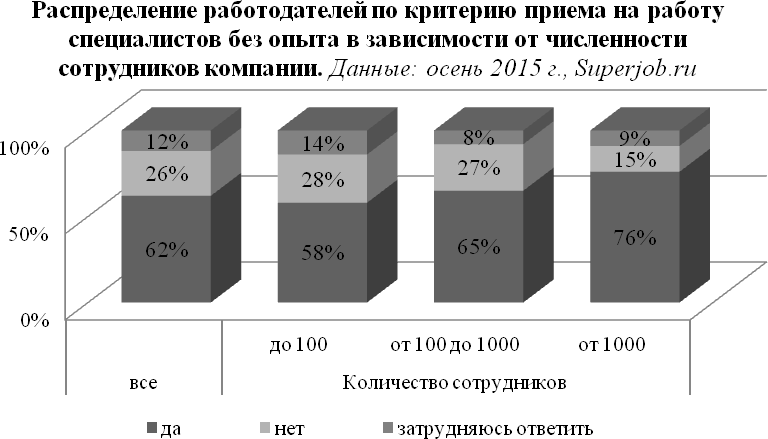
Fig. 1. Employer survey data on demand for young professionals in the labor market
However, a retrospective analysis of the data shows that interest in hiring young people peaked in 2013: at that time, 72% of respondents said that they hired specialists without experience. This is 10% higher than in the current year, 2015, and 18% higher than six years earlier, in the post-crisis year of 2009 (see Chart 2).
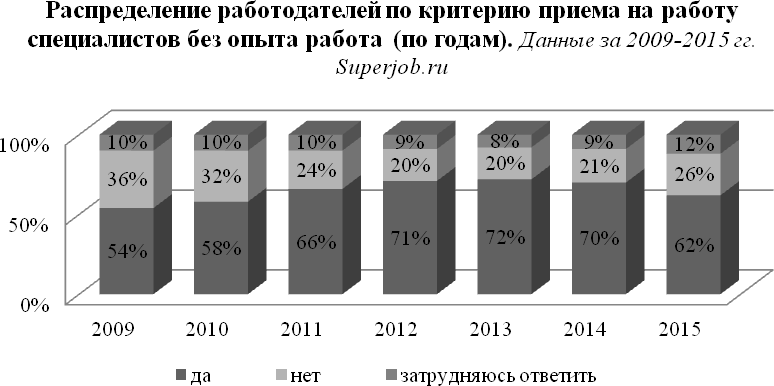
Fig. 2. Monitoring demand in the labor market for specialists without work experience based on employer surveys from 2009 to 2015
In the same survey, 850 representatives of employer companies assessed their satisfaction with the level of training of university graduates they hire (see Chart 3). Here problems arise again: on average, only 8% of respondents report being fully satisfied with the training of young professionals. Another 42% of employers say they are rather satisfied with the existing level of training. Overall, we can say that every second employer is satisfied with the training of young professionals. Or, equivalently, every second university graduate meets an employer’s requirements. Even using the most basic assessment of training quality in an educational institution, we arrive at a figure of 50%.
It should be noted, however, that the situation is not entirely poor, since only 8% of respondents are actually dissatisfied with the quality of training. In other words, out of 850 employers in 133 regions of the country, only 68 companies reported a negative experience in assessing the competencies of young professionals.
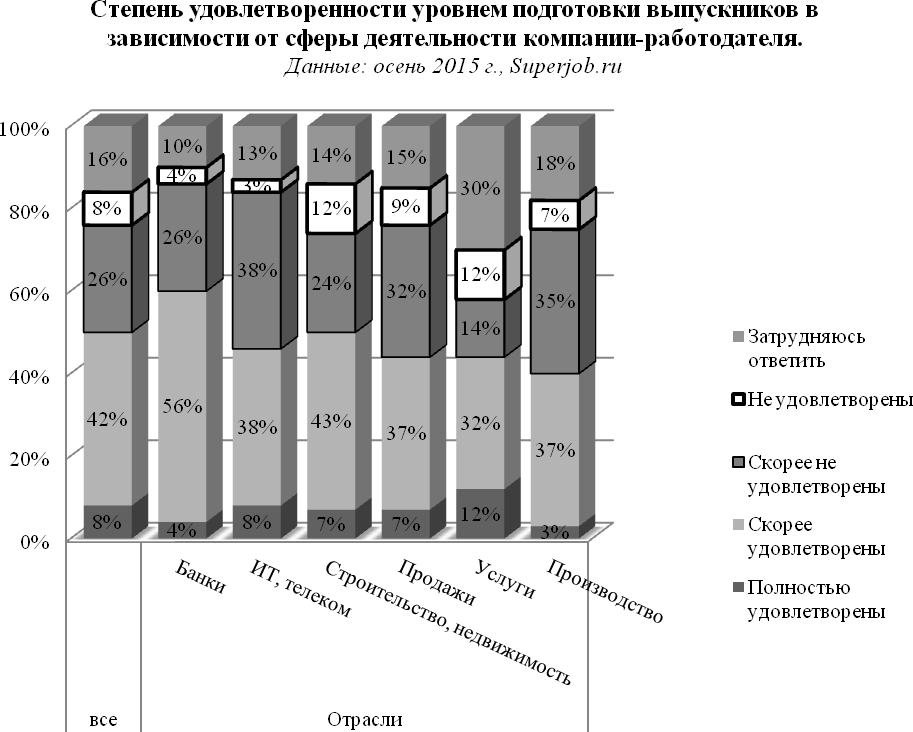
Fig. 3. Results of employers’ assessment of the quality of university graduate training, taking the company’s field of activity into account
To avoid overloading our article with somewhat “extraneous” statistics, we suggest considering the results of the latest survey, also conducted by the Superjob portal in July 2015 among 1 600 residents of 285 settlements across Russia. Among other things, they were asked to assess whether today’s schools provide graduates with a sufficient amount of useful practical skills and abilities. It was found that the highest proportion of respondents who considered the knowledge and skills received at school insufficient was concentrated among young people aged 18 to 24: 69% of respondents in this age group gave this answer.
Overall, 63% of respondents consider school preparation insufficient, while only 19% said it was entirely satisfactory.
This situation leads to one conclusion: colleges need to develop existing and seek new ways to ensure that their graduates are in demand in the labor market.
Bazhanov I.G., Head of the Graduate Employment Support Center: at this stage, the college uses several methods to increase the demand for its graduates in the labor market.
It is probably unnecessary to discuss methods of improving the quality of teaching and instruction itself, since most of them are widely used by educational organizations and contain nothing particularly new. In the context of young people’s professional development, it is more interesting to consider those activities and programs that are aimed primarily at developing and assessing the professional competencies of students and graduates.
Naturally, like many educational institutions, we participate in professional Olympiads and skills competitions at both regional and federal levels. This applies above all to information technology. Here we are not only participants: over the past five years, we have prepared tasks and provided a venue for the regional stages of the “Information Security in Automated Systems” and “Web Design” Olympiads, the World Skills Russia (WSR) championship in the “Car Painting” competency, the “Computer Master” professional skills competition, and others. The experience accumulated over this time has shown us that competition tasks become most effective and interesting when specialists in the relevant field are directly involved in their development. Our competition tasks are now developed by university lecturers who teach specialized courses at our college; in addition, some tasks are reviewed by our employer partners to assess their relevance to current real-world production needs.
Another area in which we promote the development of our graduates’ professional competencies is the active use of additional certification during training. As with Olympiads, our main focus here is our core field, IT. We are helped by the fact that the college has obtained the right to conduct official certification for Microsoft and Adobe products on its premises. If they wish, our graduates can take certification tests during their studies for many products and areas of activity offered by these companies. They receive electronic and paper certificates, and their details are entered into a unified database of certified specialists. For any employer, such certificates in a young employee’s portfolio are among the best evidence of their IT competencies. If we recall that at present 9.9% of employers identify these competencies as key for an employee, the importance of this way of “increasing the value” of our graduates in the labor market becomes even more obvious.
Of course, we actively involve our employers in reviewing curricula for specialized courses and disciplines and in the final assessment of graduates. We are also beginning to develop cooperation with them more actively in the professional development of teaching staff. We see our task as ensuring that, during training, a teacher can not only explain the theoretical foundations of a subject or teach the necessary skills in the same way they themselves were once taught. It is far more valuable and interesting when teachers themselves understand the technical subtleties of the profession and can answer narrow, not always standard or expected, questions from students. They may even share their own experience of working in modern production and, so to speak, fresh impressions — because this is exactly what our students most expect from their studies.
How did we arrive at this idea? Among other things, through our own experience. For several years we have conducted two-stage surveys of students, mainly in their third and fourth years. First we ask them to describe their expectations of practical training, and then, after completing the placement, we ask them to answer the same questions, now with practical experience behind them. The results are interesting in general, but for the subject discussed here we will cite data from only two questions. The first is: “What would you most like to gain or achieve during your placement?” Every year, about 30% of students select, among other options, the answer: “To have the opportunity to communicate with and learn from true professionals, masters of their craft.” When answering the question “What will you lack most in order to feel completely confident in the workplace?”, no fewer than a quarter of respondents consistently choose: “Demonstration during practical training of ‘difficult cases’ from the experience of teachers/instructors.”
Another interesting practice we introduced is what, for our “internal use,” we called the “traffic light.” Today psychologists work in most educational institutions; they conduct various kinds of testing with students and work with them in different training sessions, including those aimed at developing communication and self-presentation skills. Tutoring support for students is also being introduced.
At our college, by the time students graduate, we ask psychologists to prepare brief profiles of final-year students, with an emphasis on the graduates’ strongest professional and personal competencies as well as their work motivation. Wherever possible, this information is coordinated with group supervisors and tutors, so the result is a kind of brief “expert assessment” of the graduate’s personality. Based on this assessment, we conventionally divide graduates into three categories represented by traffic-light colors:
- green — the most promising students and those most motivated to work;
- yellow — students who are largely ready to work but who may, for example, have excessively high expectations of their future workplace or overly developed ambitions that are not yet proportionate to their accumulated experience and level of qualification;
- red — students who may later change their professional field or who currently plan to continue their education at university rather than go to work; students who received many disciplinary complaints while at college or experienced problems during practical training.
This helps us better understand the individual characteristics of each graduate and, as far as possible, take them into account when offering vacancies or selecting candidates for a narrowly specialized request from a specific employer, if such a request exists when the student graduates from college.
Razoryonova E.A., Deputy Director for Human Resources: I should note at the outset that before moving into business and private consulting, I worked in education for a long time and therefore know the process of training a young professional in a college quite well, so to speak, “from the inside.”
Now, figuratively speaking, being “on the other side of the barrier,” I would first like to mention a number of problems that we, as a small company working in IT, face primarily when recruiting young professionals.
One of them is the somewhat unrealistic expectations young people have regarding salaries and proposed responsibilities. As a rule, young professionals today tend to have what I would call an inflated professional self-assessment. Undoubtedly, they represent a valuable resource, because their personal and professional activity will only increase in the near future: as is well known, most specialists reach the peak of their careers and professional mastery between the ages of 30 and 35.
But when young people come from college or university, even despite the practical experience gained during their studies, they have an exceptionally poor understanding of how any organization functions. In particular, they often find it difficult to adapt to project work, where clearly defined tasks must be solved. Based on our project managers’ experience working with young people, I can say the following: even if a young specialist is professionally well prepared — and where this is not the case, some projects allow us to further develop their potential by solving production tasks from simple to complex — observing the chain of command within a project and limiting their creative impulses in favor of the most efficient and rapid solution of tasks is often a real difficulty for them.
I fully agree with the employer surveys cited at the beginning of our article, which indicate that one of the most sought-after personal competencies in a young employee is responsibility. This should be understood as the employee’s willingness to accept that the results they obtain are consequences of their own decisions, actions, and competencies to exactly the extent that they apply them in their work. From this perspective, young employees are often insufficiently responsible in the sense that they have difficulty assessing the impact of their own professional actions and individual professional results — in solving a particular task — on the outcome of the team’s work as a whole.
For a young specialist who has just left an educational institution to adapt to new conditions and a new role with minimal costs for both sides — themselves and the employer — it is probably necessary, already at the stage of completing their education, to assess and develop a number of professional competencies that are most in demand in the labor market at that particular time, or to do so with the requirements of specific employers in mind. Various schemes of cooperation between employers and educational institutions can be developed here, aggregating these requirements to a certain extent and combining them into groups and broader competencies demanded by an industry as a whole, or at least by one of its segments.
Instead of a Conclusion
It is easy to see that, in terms of the technologies and principles coming to the forefront, education is gradually moving closer to the business sector. Principles of organizational management and performance assessment are becoming similar, and approaches to teaching both students and instructors are being introduced that resemble business training.
In line with these processes, we believe it would be interesting and useful to introduce into educational institutions, during the final years of study and/or upon graduation, for example, one personnel-selection technology: competency-based interviewing. As is known, the essence of this method is to create, with expert involvement, a list of key competencies for each position, a high level of which serves to some extent as a guarantee that an employee will be economically effective in that role. Each competency has a set of behavioral indicators — that is, signs expressed in an employee’s behavior and activities — that make it possible to assess its level of development and predict the employee’s success. This, of course, is a very concise and somewhat simplified description.
Professional and educational standards are now being built precisely on the basis of developing and assessing sets of competencies in students. However, as we said earlier, these competencies do not always meet market requirements; sometimes they lag behind them, and sometimes they relate to those requirements only indirectly. At the same time, as a rule, virtually every educational institution today has a fairly stable base of employer partners that provide practical-training placements and later hire graduates.
In this situation, it seems logical to analyze specialized fields of study at the level of individual educational institutions or, for example, UPOs — training and production associations currently established in Moscow — specifically in terms of their “competency composition.” Representatives of interested employers should be involved in this work so that a maximally complete “professional and behavioral profile” of the desired young specialist can subsequently be developed. The next step would be to develop behavioral indicators for each competency and criteria for its degree of expression, which in turn would make it possible, at least to some extent, to formally assess how well these competencies have been developed.
During the final years of study, practical training, and the preparation and defense of the final qualification project, not only employees of the educational institution but also employer representatives gain an opportunity to assess these competencies and to approach the employment of young specialists or their additional training more consciously, if this concerns a pre-graduation year.
Opportunities for this are created through distance-learning technologies and additional targeted courses and modules offered to students in their final year. Filling the variable part of the curriculum with more in-demand and narrowly specialized content, made possible by having a “real competency profile” of a specialist, will make the learning process itself more interesting and relevant to young professionals, thereby also addressing the issue of learning motivation.
References:
- Ivanova S.V. Assessing Competencies Through Interviews: A Universal Guide. — Moscow: Alpina Publishers, 2011. — 155 pp.
- Young Specialist: State Policy, Education and the Country’s Production Sector: Proceedings of the All-Russian Conference [Text] / M.N. Nazarova, ed. — Krasnoyarsk: Siberian Federal University, 2010. — 121 pp.
- Recruitment and Personnel Management: Industry Benchmarks. Short Version of the Report / Research Center of the Superjob.ru Portal. — 2015. — 13 pp.
- 64% of Russians believe that school education in Russia is now worse than it was 10 years ago / Research Center of the Superjob.ru Portal. — 2015.
- Young professionals are most welcome in IT and banking / Research Center of the Superjob.ru Portal. — 2015.
- The State of the Labor Market for Young Professionals in Moscow. Main Trends of 2014.
- Uzhakina Yu. Trends. Providers. Customers [Electronic resource www.trainings.ru.] — 2010.