



Davos 2024
 The 2024 World Economic Forum took place in Davos from January 15 to 19. It was the Forum’s 54th Annual Meeting and was held under the theme “Rebuilding Trust.” More than 2,500 leaders from governments, business, and civil society took part in the event, along with representatives of academia and youth movements from around the world.
The main topics of the forum:
- Security and cooperation in a fragmented world: Participants discussed ways to address current geopolitical crises effectively, including the situation in the Middle East and Eastern Europe, as well as opportunities for international cooperation.
- Creating jobs and growth for a new era: Strategies aimed at preventing a decade of low economic growth and measures to improve people’s prosperity were discussed.
- Artificial intelligence (AI) as a driving force of the economy and society: Attention focused on the safe implementation and regulation of AI, as well as its impact on global markets and society as a whole.
- Climate, nature, and energy strategy: The forum continued discussions on climate change, the energy transition, and achieving carbon neutrality by 2050.
The event was also attended by prominent political leaders such as French President Emmanuel Macron, Chinese Premier Li Qiang, Ukrainian President Volodymyr Zelenskyy, as well as leaders from other countries representing different regions of the world.
Job Creation and Economic Growth
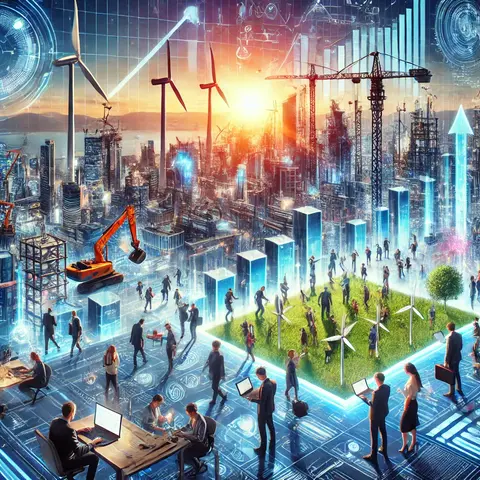 At the 2024 World Economic Forum, job creation and economic growth in a new era was one of the key topics. Discussions addressed changes in the global labor market caused by digitalization, automation, changing economic models, and new challenges such as climate change and geopolitical instability.
It was discussed that traditional approaches to economic growth and job creation are no longer effective in the face of current global challenges. Leaders emphasized the need to move toward new models that place people at the center of economic activity. This requires developing strategies that promote job creation, ensure sustainable development, and take new economic realities into account, including digital transformation and environmental sustainability.
The forum acknowledged that technological innovations, such as artificial intelligence and automation, are significantly changing the labor market. On the one hand, these technologies create new opportunities and professions; on the other, they also lead to job losses in traditional industries. Forum participants discussed the importance of investing in education and retraining employees to help people adapt to new requirements and find work in high-tech sectors.
Forum participants emphasized that both government and the private sector must work together to create conditions that support economic growth and employment. Measures to support small and medium-sized businesses, stimulate innovation, and provide accessible education and training were discussed, which is especially important for young people and vulnerable population groups.
The forum emphasized the need for creating jobs related to sustainable development and environmental initiatives. The green economy and the transition to carbon neutrality by 2050 are viewed as important drivers of future job creation. Participants discussed how to stimulate the development of “green” industries such as renewable energy, waste recycling, and clean technologies.
Another important aspect of the discussions was ensuring inclusive growth, which affects all segments of society. Particular attention was paid to inequality and the need to create jobs for all categories of citizens, including young people, women, and members of vulnerable groups. Forum participants discussed mechanisms that could contribute to a fairer distribution of the benefits of economic growth.
Thus, the 2024 forum discussed new approaches to job creation and economic growth that take into account current and future challenges such as technological change, climate threats, and the need for inclusive development.
Artificial Intelligence (AI) in Davos
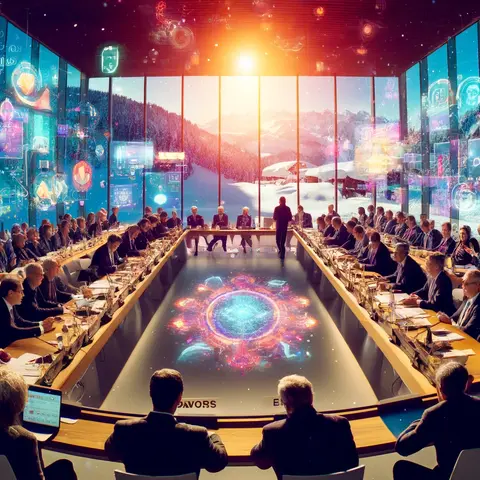 At the 2024 World Economic Forum, artificial intelligence (AI) took a central place in the discussions, reflecting its growing importance for the economy and society. Let us consider the key points addressed at the forum.
AI was described as one of the most powerful and transformative technologies of our time. Forum participants emphasized that AI has the potential to become a key driver of economic growth, innovation, and improvements in quality of life. At the same time, risks associated with its implementation were also acknowledged, such as possible social and economic imbalances.
Particular attention was paid to the need to create ethical and legal frameworks for governing AI. Issues related to protecting data privacy, preventing algorithmic bias, and ensuring transparency in the use of AI were discussed. Leaders noted that without appropriate regulation, AI could become a source of inequality and widen social divides.
One of the key issues was the effect of AI on the labor market. Forum participants noted that, on the one hand, AI can automate many routine tasks, freeing workers for more creative and highly skilled activities. On the other hand, this can also lead to significant changes in employment, requiring people to continually retrain and adapt to new conditions.
AI was also considered a catalyst for innovation across various industries, from healthcare to manufacturing. The forum discussed examples of successful AI applications, including its use to accelerate scientific research, improve medical diagnostics, and optimize manufacturing processes. Participants emphasized the importance of international cooperation in the development and implementation of AI to ensure its broad distribution and accessibility.
Questions were raised about how to manage risks associated with AI, including cybersecurity, the spread of disinformation, and social polarization. The Global Risks Report presented at the forum noted that AI’s growing capabilities for creating and spreading false information could become a serious threat to.
Overall, at the 2024 forum, AI was presented as a powerful tool that can both contribute to global progress and create new challenges requiring a coordinated international approach to address them.
Conclusion
The 2024 World Economic Forum (WEF) in Davos once again confirmed its significance as a key international platform for discussing global challenges and seeking solutions. In an increasingly complex and unstable world, the forums in Davos provide a unique opportunity for leaders from different countries and sectors of the economy to come together, discuss pressing issues, and develop strategies that may shape the future of the world order.
Countries that do not attend the forums in Davos deprive themselves of the opportunity to influence discussions and the shaping of decisions concerning global issues. This puts them in a less advantageous position compared with countries that actively participate and present their ideas and approaches. Participation in Davos offers unique opportunities to establish international connections, create new partnerships, and attract investment. Countries that do not participate lose these opportunities, which may slow their economic development and innovative potential. In addition, forums in Davos are a source of valuable experience and knowledge. By not participating in these forums, countries may miss important trends and practices, making it more difficult for them to adapt to a rapidly changing global context.
The forums in Davos remain an important platform for international dialogue and cooperation. They help shape the future of the global economy and society by creating opportunities for innovation and sustainable development. Countries that do not participate in these forums risk remaining on the sidelines of global processes, which may negatively affect their long-term development and international influence.