



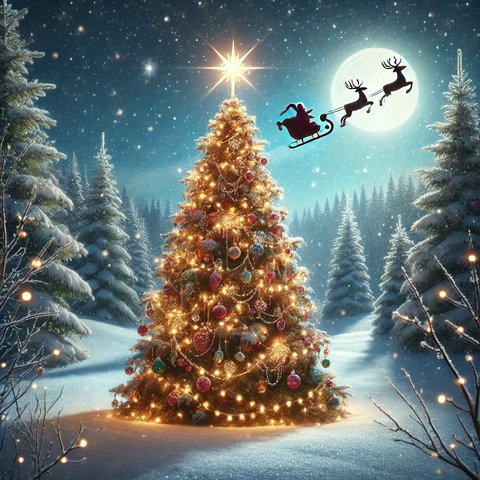
 Christmas as a holiday did not originate with one particular person but developed within the Christian tradition. It is a Christian celebration commemorating the birth of Jesus Christ. Its establishment is connected with the history of the Church, and Christmas was first celebrated in Rome in 336 AD. Traditionally, December 25 was chosen as the date for celebrating Christ’s birth, although the exact date of his birth is unknown. The holiday later spread throughout the Christian world.
Before Christmas became a Christian holiday, various cultures already had festivals in late December associated with the winter solstice, such as the Roman Saturnalia and the Scandinavian Yule.
Saturnalia
Saturnalia was one of the most popular and important festivals in Ancient Rome, dedicated to Saturn, the god of agriculture, harvest, and time. The celebration resembled a carnival, combining religious rituals, festive entertainment, and a temporary reversal of the social order.
Saturnalia was held from December 17 to 23. During this time, Romans organized large feasts and celebrations, exchanged gifts, and played various games. Here are several key aspects of the festival:
Suspension of social norms: One of the most striking features of Saturnalia was that many social norms and hierarchies were temporarily relaxed. Slaves were often encouraged to join the festivities alongside their masters and could ask them for treats or small gifts. In some households, slaves were even given greater freedom and allowed a temporarily less restricted status. This created a sense of social equality.
Games and entertainment: Games and competitions were an important part of Saturnalia, including divination, dice, role-playing games, theatrical performances, and masquerades. Many Romans wore bright clothing, sometimes masks or costumes, and took part in celebrations resembling carnival festivities.
Feasts and treats: Saturnalia was a time of abundant celebrations and food. People arranged lavish feasts with many dishes, including meat, sweets, wine, and other delicacies. Tables could also include special foods associated with harvest themes and winter celebrations.
Gifts: During Saturnalia, it was customary to exchange gifts, mainly small symbolic items such as candles, toys, ornaments, and sweets. This also resembles the tradition of exchanging gifts that still exists at Christmas today.
Religious aspect: Saturnalia was connected with religious rituals, especially the worship of the god Saturn. Sacrifices, prayers, and ceremonial rites were performed in his honor. In antiquity, Saturn was believed to symbolize fertility and the period when the land rested from agricultural work.
Saturnalia had a noticeable influence on later Christmas traditions. For example, gift-giving, feasts, and celebrations of light are often associated with the development of similar Christmas customs.
Yule
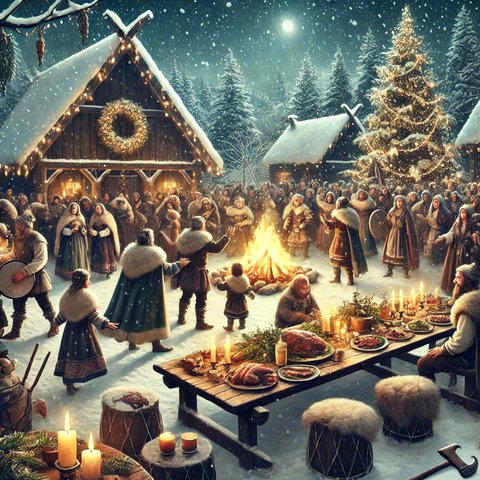 Yule (or Jol) is an ancient Scandinavian festival originally associated with the winter solstice and the worship of gods and nature. It was celebrated in Scandinavian lands as well as in other parts of the Germanic world, including England and Germany. Yule was an important time for Scandinavian peoples and symbolized the struggle between light and darkness and the return of the sun.
Here are several main aspects of the Yule festival:
Connection with the winter solstice: Yule was celebrated during the darkest time of the year, around the winter solstice, when the day was shortest and the night longest. This period was seen as the moment when light began to overcome darkness and each new day became longer. The return of the sun was an important symbol of the festival and was expressed through fires and fire rituals.
Yule tree (Christmas tree): One of the best-known traditions associated with Yule was the use of a tree symbolizing life and rebirth. In ancient Scandinavia, a tree, especially an oak or fir, was decorated with candles, lights, garlands, and other symbols. The decoration represented a longing for light and fertility. The custom of decorating a tree was later adapted into Christian Christmas traditions.
Feasts and treats: Yule was a time of large feasts and abundant food. Meat dishes, pies, honey, and other treats appeared on the table. Festive gatherings were accompanied by singing, music, and dancing. It was a time when people came together to celebrate the return of light and warmth.
Yule boar: One popular tradition was the sacrifice of a pig in honor of the god Freyr, the god of fertility and harvest. The pig symbolized abundance and prosperity, and its sacrifice was believed to bring good fortune in the new year. This tradition later evolved into Christmas customs involving roast pork.
Fires and candles: Yule was associated with fire as a symbol of the victory of light over darkness. Bonfires, candles, and special lights were lit during the celebrations and were believed to drive away evil spirits and dark forces.
Yule boar and Yule goat: In addition to the pig, Scandinavian traditions included mythical figures such as the Yule Goat. It was regarded as a guide and a symbol of merriment, and later became associated with Christmas goat figures that still exist in some countries.
Festive traditions: Some traditions connected with Yule have survived in modern culture, such as decorating the Christmas tree, exchanging gifts, and using symbols such as Santa Claus, who is also sometimes linked with northern myths about a kindly old man. Scandinavian Yule traditions influenced the development of Christmas customs in different countries.
Thus, Yule was a celebration of the bright transition from winter toward spring, and it helped Scandinavians raise their spirits through the belief that every new day would bring more light and warmth.
Christmas and Charles Dickens
Charles Dickens played an important role in popularizing Christmas as a family holiday in Britain and other countries. Although Christmas had existed for centuries, its celebration in the mid-nineteenth century was not as vivid and widespread as it is today. Dickens's work "A Christmas Carol" (1843) had a major influence on the way Christmas came to be perceived.
In this novella, one of the best-known and most beloved Christmas stories, Dickens described a spirit of kindness, compassion, and generosity that should lie at the heart of Christmas. The main character, the miser Ebenezer Scrooge, is transformed after meeting the spirits of Christmas and becomes a more generous and caring person. Inspired by kindness and the moral lessons of Christmas, the story emphasizes family values, goodwill, helping those in need, and closeness with loved ones.
After the novella was published, the popularity of Christmas grew considerably, and traditions such as gift-giving, festive dinners, carol singing, and family gatherings became more widespread in society. In this way, largely thanks to Charles Dickens, Christmas came to be seen as a time when it is important to bring joy and care for others, not merely as a religious or secular holiday.
Where Did the Tradition of Decorating a Christmas Tree Come From?
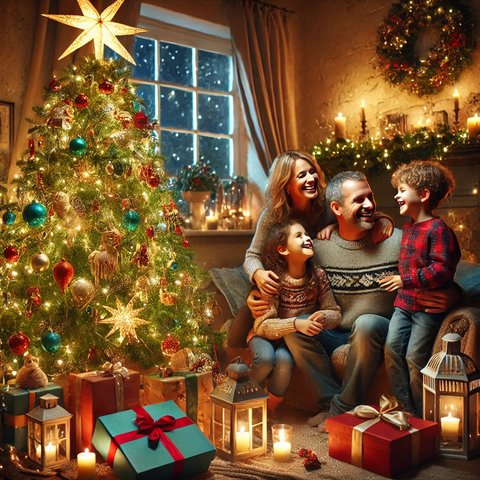 The tradition of decorating a Christmas tree has a long history that begins in Germany in the sixteenth century. It is often said that the first person to use a tree as a symbol of Christmas was the German Protestant reformer Martin Luther. According to legend, he was inspired by the beauty of a winter night while walking home and seeing stars shining through the branches of an evergreen tree. To recreate this wonder for his children, Luther decorated a tree with candles.
Later, in Germany, the tree became a symbol of Christmas and was decorated not only with candles but also with ornaments such as apples, nuts, and sweets. In the eighteenth century, Christmas trees began to be placed in homes, especially among aristocratic families.
The custom of decorating a Christmas tree spread to other countries in the nineteenth century, especially through the British royal family. In the 1840s, after Queen Victoria married the German Prince Albert, he helped popularize the custom of decorating a Christmas tree in England. A famous engraving showed the royal family beside a tree decorated with candles, apples, and other ornaments. The image became a symbol of the Christmas tradition, and the fashion for decorating trees gradually spread throughout Britain and other countries.
Since then, decorating the Christmas tree has become an integral part of Christmas celebrations in many countries, while decorations have become increasingly varied, including garlands, ornaments, lights, and other decorative elements.
Christmas in Psychology and Psychotherapy
Christmas is sometimes discussed in psychology and psychotherapy, but in this context it is usually considered not as a religious holiday, but as a cultural and emotional phenomenon that can influence a person's psychological state. In psychotherapy, Christmas and New Year holidays often become topics of discussion because they may evoke a wide range of emotions, both positive and negative.
Some aspects of Christmas that may be important in psychotherapy include:
Family relationships: Christmas is often associated with family gatherings, and for many people this period can be a source of both joy and stress. Expectations of an ideal family celebration may clash with the reality of tense family relationships. Psychotherapists may work with clients to help them cope with conflicts or emotional experiences connected with the holidays.
Loneliness and depression: The holiday season may also intensify feelings of loneliness, especially for people experiencing bereavement, divorce, or separation from loved ones. Seasonal depression, sometimes referred to as "holiday depression," may appear as sadness, anxiety, or loss of interest in life. In such cases, psychotherapy may help people find ways to cope with these feelings.
Stress and expectations: Deeply rooted cultural ideas about Christmas as a time when miracles or perfect events should happen can create stress. People may feel pressure to buy gifts, plan celebrations, and follow traditions, which can affect their emotional well-being. Work with this issue may include reducing stress and reconsidering expectations.
Forgiveness and change: The Christmas season may also be a time when people reflect on their past, decide to forgive, and think about inner renewal. In psychotherapy, this can be a useful opportunity to work on forgiveness, reassessing one's actions, and setting goals for the future.
Therapeutic practices related to Christmas: In some therapeutic approaches, such as art therapy or family therapy, holidays may be used as a tool for working with emotions, establishing traditions, or reflecting on the meaning of family and community.
Thus, although Christmas is not a central concept in psychology or psychotherapy, it can be an important subject for discussion in the context of personal experiences and social interactions that occur during this period.