



 It seems that everyone talks about stress these days. We read advice on social media, download apps for breathing exercises, and hear people say “I’m stressed” a hundred times a day. The word has almost become fashionable — as if we all have to live a little “on the edge” to keep up with the spirit of the times.
But here is the paradox: the more we talk about stress, the less we seem to understand what it really is. We are used to thinking of it as something temporary and superficial — you did not get enough sleep, had an argument, submitted a report. You got through it and moved on. But the body and mind do not see it that way. They register every strain, every worry, and every moment when you tell yourself once again, “I’ll just endure a little longer.”
In reality, stress is not simply “getting nervous and then calming down.” It is a powerful biopsychological process that can mobilize us in a difficult moment, but can also gradually wear us down when it becomes a normal background state in our lives. The important thing is to learn to notice where ordinary tiredness ends and real overload begins.
That is what we will talk about in this article: what stress really is, how it affects our behavior and our body, and how we can cope with it — not with magical techniques or mantras, but with understanding and respect for ourselves.
What Is Stress and Where Does It Come From?
 Sometimes it feels as though we live in a world where stress has become an ordinary part of life: you work — so you are expected to be on edge; you raise children — prepare for sleepless nights; you turn on the news — and there is anxiety again. But if we stop waving it away with “everyone lives like this,” it becomes clear that stress is not just background noise. It is a signal.
It is the body’s way of saying: “Something is wrong.” And it does not switch on only when something truly dangerous is happening — when you are in danger or a bus is rushing toward you. It also appears in much more “peaceful” situations: when you are late with a report, when you argue with someone close to you, when another email marked “urgent” arrives. We encounter stress every day. Here are a few examples:
- You are overwhelmed at work and have no idea how you will get everything done.
- Friends invite you out, but you have absolutely no energy for anyone.
- You argued with your partner, and now a million thoughts keep circling in your head — who said what, what they meant, who was to blame.
- You wake up at night and remember that you forgot to pay the bills.
- You get a message from your boss containing one word: “Call me.” That is all. And the blood drains from your face.
That is stress. Sometimes it is brief, sometimes it lasts the whole day. And sometimes it stretches on for months. Nothing especially dramatic seems to be happening, yet you walk around wound tight like a string and cannot even explain exactly why.
What is interesting is that the same situation can feel completely different to different people. One person sits calmly in a traffic jam listening to a podcast, while another loses their temper after ten minutes. Why?
Because we are all different. One person has had a difficult day. Another did not sleep enough. Someone grew up in a family where being late was punished, so the automatic thought is now “I’m bad.” Someone knows how to ask for help, while someone else is used to handling everything alone. Sometimes the “glass” is simply already full, and one more drop is too much.
So stress is not weakness and not proof that you cannot cope. It is a normal, living response. The problem begins when we pretend not to notice it and keep carrying everything ourselves as though that were simply how life is supposed to be.
How Stress Changes Our Behavior, Body, and Thoughts
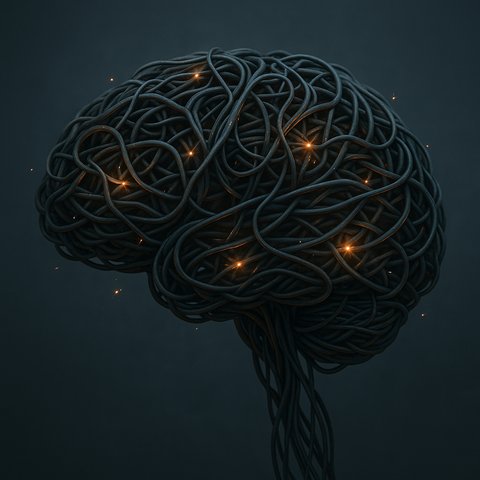 When people say “I’m stressed,” they usually mean fatigue, irritation, and the desire to drop everything and run away to the woods. But the truth is that stress is not just an emotion. It is a process that runs through the whole body — from biochemistry to the way you talk to the people closest to you.
It all begins innocently enough. You simply cannot concentrate. You open a tab and forget why. You sit in a meeting while your mind keeps drifting elsewhere. You go to bed, and anxious thoughts start circling as though someone pressed a button labeled “run this on repeat.” You wake up in the morning feeling as though you did not sleep at all.
You become more irritable. Where you would once have shrugged something off, now there is an inner explosion. Someone’s voice sounds aggressive even if they are only asking a question. Or the opposite happens — you simply freeze and stay silent so you do not explode, while everything inside is boiling.
You begin putting off even simple tasks. Not because you are lazy, but because every action feels as though it requires enormous effort, as if you were dragging a bag of cement. You can call it procrastination, but in practice it is often simply the response of an overloaded mind saying: “Please give me at least a little rest.”
Now let us look at what is happening inside. When stress lasts a long time, the body remains in a state of alarm. The pulse is faster, breathing becomes shallower, muscles stay tense, and cortisol levels can remain elevated. The unpleasant part is that this does not always switch off automatically. You may be lying down, but your body behaves as though you are running. And this can continue day after day.
The problem is that the body is not designed to live in constant alarm. Stress was meant to be short-lived — notice danger, react, get away, recover. But in modern life it can become background noise. It accumulates. One night of poor sleep, another argument, a third unpleasant task — and soon you are walking around with a constant inner hum, like a transformer.
It is like driving a car while keeping the brake pressed. You are moving, but with wear, overheating, and constant friction. Over time this can contribute to chronic health problems, poor sleep, stomach problems, blood pressure changes, burnout, and anxiety disorders. The body’s warning signs may have been ignored for months, sometimes even years.
There is another tricky part: you may not immediately realize that stress is the cause. You start criticizing yourself for being lazy, distracted, or “unable to pull yourself together.” But in reality, your body may simply be shouting that things have become too difficult.
Stress is not the enemy. It is more like an alarm button saying: “Stop. Pay attention. Something is wrong.” If you learn to hear it, you may be able to prevent a breakdown. The main thing is not to treat it as weakness. It is biology. It is part of being human.
What Helps: A Psychological Perspective
 “Just relax” has firmly taken first place on the list of useless advice. When you are truly on edge, tense, or close to your limit, you cannot simply “relax.” Because this is not a matter of willpower. It is like telling someone: “Come on, pull yourself together, get up and go.” It sounds simple — just stand up and move — but sometimes that is very difficult in practice.
To begin steering yourself out of it, even a little, it is more useful not to force yourself to “keep going,” but to shift attention toward what might actually help. Not to “change your whole life” at once, but simply to loosen the grip inside a little. Let us start with the basics. What can help?
1. Breathing
For example, begin with your breath. You do not have to sit in the lotus position and start a meditation. Just stop. Take a slow breath in. Hold it for a moment. Exhale slowly. Continue for at least a minute. It may sound silly, but the point is that while you breathe consciously, you regain a little sense of control. You are no longer completely on autopilot. Your body gets the message: “Things are under control.” This will not make you completely calm, but it can give you something to hold onto so the anxiety does not spiral further.
2. Boundaries
Next come boundaries. This may be the hardest part, especially if you are used to being easy to deal with — agreeing, helping, taking on extra things. And then lying there exhausted, thinking: “Why does nobody take care of me?” Because you are not taking care of yourself either. A boundary is not a wall; it is simply an honest answer to yourself: I cannot do this right now, I do not have the energy, I do not have to. And yes, someone may be upset. But the alternative is burning out again and again and then trying to put yourself back together.
3. Rest
And here is another thing that really matters: real rest. Not the kind where you spend half the day scrolling and then feel even worse. The kind after which you genuinely feel a little better. It can be anything — going outside without your phone, lying quietly, doing something with your hands. The important thing is not to do it for productivity or to tick a box, but simply because this is what you need right now. To give yourself permission to stop and relax.
4. Support
And, of course, conversation. Talking to a friend, a hug, a simple “I understand” — these are not trivial things. We are social beings, and loneliness can intensify stress. One of the simplest ways not to drown in it is to tell someone: “I’m having a hard time.” You do not have to explain everything in detail. Sometimes it is enough simply to speak and be heard — without advice, without “well, I...,” just heard.
But one thing matters: no technique will work very well if inside you keep thinking, “It’s my own fault,” “I just need to endure,” “A little longer and everything will sort itself out.”
Stress becomes chronic not because life is difficult, but because we stubbornly refuse to change our attitude toward what is happening.
As long as you see fatigue as weakness and anxiety as an inconvenience, nothing will move. But when you tell yourself, “This is hard for me, and that is understandable,” you finally create a chance to change something.
And one more important thing: none of this is “once and for all.” It is not a magic pill. It is about regaining a little support at a difficult moment so you do not completely fall apart. Then you can try again. And again. Over time, you may find the strength to change deeper things — habits, work, relationships, the way you see yourself.
When It Is Time to Stop and Ask for Help
 There is a moment we often miss. The moment when stress is no longer just temporary tiredness, but almost a way of life. When “I’m running on autopilot” stops being a joke and becomes everyday reality. Things still seem to function: you get up, work, manage to get things done, even smile at people. But inside there is a dull background hum, as though you are living behind glass. Plenty of noise outside, but you feel farther and farther away from yourself.
At times like this, people often tell themselves: “just a little longer,” “it’s just a difficult week,” “once I deal with this, things will get easier.” But then it is not a week. It is a month. Or six months. And things do not get easier. You simply get used to it — to living with tension, heaviness, and no energy. Losing your sense of enjoyment starts to feel “normal.”
The line between “a normal reaction to pressure” and “that’s it, I’m burned out” is not always clear. Stress does not strike like an electric shock. It creeps in. It slowly takes away energy, attention, sleep, and then emotion. Eventually good news no longer makes you happy and bad news no longer makes you angry — you simply do not care. A dull apathy. Or, on the contrary, chronic anxiety: the constant feeling that something bad is about to happen even though objectively nothing is happening.
The time to ask for help is not when you “cannot go on anymore.” It is much earlier. When you realize there is almost nothing left inside — no desire, no interest, no sense of “I am still myself.” When you are tired not only of work, but of the sheer fact of existing. When weekends no longer restore you. When you have become a stranger to yourself.
And here it is important to say one simple thing. Asking for help does not mean losing. It does not mean you are weak, dependent, or “unable to cope.” On the contrary, it means you have finally heard yourself. You respect your limits. You recognize that you are a living person, not a resource that can be used endlessly.
A psychologist is not “for crazy people.” It is for people who are tired of carrying everything alone. For people who want to understand why things feel this way and what could be different. And often simply for people who need a safe space where they do not have to keep up appearances, explain, or justify themselves. A place where they can simply be and try to feel again that they are living rather than merely existing.
A healthy relationship with yourself is not about perfect balance, time management, and regular yoga. It is about honesty. About knowing when to stop. About admitting that you are not limitless. That you need not only to work, perform, care, and carry things — but also to recover, step back, change direction. Sometimes to begin again.
Paradoxically, the people who “can handle everything” are often the ones who eventually reach the limit. Because they did not listen to themselves for a long time. Because they believed, “I’m strong, this won’t happen to me.”
And then it did. And perhaps that is when, for the first time in a long while, a chance appears for something real. For yourself. The real you. Not squeezed dry, not exhausted, not merely “functional,” but alive.
Afterword
 Stress is not the enemy. It is simply saying: “Hey, things are hard for you. Pay attention.”
And all we can really do is not silence it or drown it out with another task or another series, but listen. With respect, without rushing, without blame.
Every one of us needs to stop from time to time. Not because we are broken, but because we are alive. Because we have limits. And we have the right to have them.
If you recognized something of yourself in this article, that is already an important step. From here, you can move slowly. You do not have to change everything at once. Sometimes it is enough simply to stop pretending that everything is fine.
And then — a little more softness toward yourself, a little more care, a little more attention. And permission not to be made of iron.