



Have you ever noticed how this works? You spend days struggling with something — trying to memorize new words in a foreign language, learn a few chords, or master a new trick on roller skates. You look at yourself and think: “That’s it, this just isn’t for me.”
Then you drop it because you are simply tired of trying. A week passes, then another — life goes on and other things take over. And then, almost by accident, you return to that same activity and suddenly realize that something has changed. Where everything used to fall apart — whether in your hands or on the tip of your tongue — there is now a surprising sense of ease. You feel more confident, movements or words seem to come together almost by themselves, and most importantly, the heaviness in your head is gone.
For many people, this feels a little puzzling. How can that be? You did not practice — and yet somehow you improved? It can seem almost like magic or coincidence. But in fact, there is a perfectly understandable and very interesting mechanism behind it. A pause is not empty time. For the brain, a break can sometimes be more important than endlessly trying to “force” the material into your head all at once.
Why does this happen? Why is it sometimes better to stop than to keep racking your brain? In this article, we will look at what the brain does while you rest, how this “secret workshop” inside our heads works, and how you can use this knowledge to your advantage.
The Brain Works Even When You Don’t
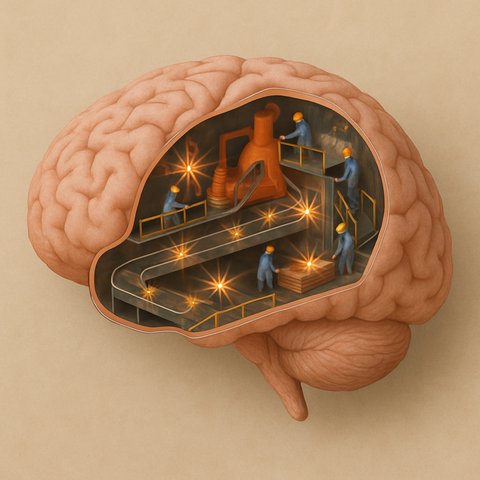 The most remarkable thing about our brain is that it does not know how to “switch off.” Even when you decide, “That’s enough, I’m done learning these words,” or put the guitar aside, it keeps working behind the scenes.
This hidden process is called incubation — the brain continues digesting and sorting everything you have put into it even while you are busy with something completely different. You may think you are doing nothing, but inside, a major cleanup and rebuilding operation is taking place at the same time.
What is happening there? Put simply, your brain is an enormous network of billions of neurons. When you learn something new — words, movements, chords — new connections form between neurons, like paths through a forest. At first, those paths are narrow, winding, and interrupted in places. When you practice long and hard, you tread them more and more clearly — but even when you get tired and stop, the work does not end.
While you sleep, rest, or simply think about something else, these paths grow stronger: the brain “cleans up” unnecessary connections, strengthens useful ones, and reduces noise. Scientists call this process neural plasticity — the brain’s ability to reorganize itself. Thanks to it, you can learn to roller-skate or study German at 30, 40, or 50, just as you could in childhood.
The most interesting part is that the brain likes to do this quietly. You may be sitting in traffic, watching a series, or simply staring at the ceiling — while somewhere deep inside, your experience is being “packed” into long-term memory and your skills are gradually being “polished” without conscious effort.
That is why it is sometimes so important to stop. Not to “give up,” but to give yourself permission to pause so the brain can finish what has already been started. And when you finally return to the original task, you may suddenly feel that everything has become much easier: your thoughts are clearer, your hands move more confidently, words come out on their own. That is incubation in action!
Sleep — the Smartest Tutor
 It seems strange: you are apparently doing nothing, your eyes are closed, your body is still — yet the brain is working in ways it cannot during the day. Sleep is not merely a break from activity. It is a separate and essential part of learning.
Scientists have long known that sleep consists of several stages. The most important for us here are slow-wave sleep and rapid eye movement sleep, or REM sleep, which is also strongly associated with dreaming. These stages help ensure that what you tried to understand and remember during the day does not simply disappear, but becomes more firmly established in memory.
While you sleep, the brain seems to sort through everything accumulated during the day: “This is important — keep it; this is useless — discard it; this may be useful tomorrow — improve it.” This sorting happens in waves. First comes slow-wave, deep sleep, when the brain processes facts and relatively straightforward information. Then comes REM sleep, during which emotions, images, and links between different parts of memory are processed especially actively. In this phase, the brain also “rehearses” complex things: body movements, pronunciation, new words, or melodies.
There have been many experiments in this area. For example, musicians or athletes are asked to learn a new sequence of movements — a piano passage or a series of actions. If they do not sleep afterward and immediately keep repeating it, progress may be minimal. But after a normal night’s sleep, their movements are often more accurate, smoother, and faster in the morning, even though nobody trained them during the night.
This effect is especially noticeable in anything involving motor skills and language — where it is important not merely to “know,” but to act quickly and without conscious deliberation. You can repeat a foreign-language rule a hundred times, but if you do not give the brain a chance to calmly “run through” it at night, by morning things may still be mixed up in your head.
Another interesting point is that while you sleep, the brain can sometimes “discover” what you could not understand during the day. Many people notice that they wake up in the morning and suddenly see a solution to a problem they struggled with the day before. This is not magic — the brain spent the night building new connections that you could not reach consciously during the day.
That is why one of the biggest mistakes is stealing sleep in order to “study just a little more.” Most of the time, that does not help. On the contrary, a couple of hours of sleep can sometimes do more for learning than another hour of cramming in the middle of the night.
So if you want to learn faster, do not forget to go to bed, and do not assume that you are being lazy. You are not being lazy — you are switching on your smartest tutor, one that works for free and without your intervention on some of the most difficult parts of the job.
Overwork Interferes with Learning
 Almost everyone has been through this: you sit over a book or lesson all evening, your eyes are red, your brain is buzzing, but you still think, “Just a little more! I’ll push through and then it will click.” Instead of clarity, however, you get irritation and fatigue. And the longer you keep going, the less chance there is that anything will stay in your head.
The problem is not weak willpower or laziness. Quite the opposite: overwork is a normal signal that your brain has reached its limit. The brain can process new information only up to a certain point — especially when the material is difficult or unfamiliar.
When you learn, neurons — brain cells — exchange signals, building new connections or strengthening old ones. This process requires energy. The brain is one of the body’s most energy-demanding organs: it makes up only a few percent of body weight but uses roughly 20% of the body’s energy. When you hammer away at the same thing for hours without sleep or rest, resources are depleted. At some point the network begins to slow down, signals are processed less efficiently, and new connections become harder to reinforce.
Scientists sometimes describe this as an overlearning effect. If you repeat material to the limit without giving yourself pauses, the brain does not have enough time to sort through everything you have loaded into it. Imagine throwing new clothes into a closet without putting them on shelves. Eventually everything lies in a heap and you cannot find what you need. Information can feel much the same: without a break, the brain has less opportunity to organize it into memory.
This is especially noticeable with skills that require precise automation — roller-skating, playing an instrument, or pronunciation in another language. If you keep forcing an exhausted body and overloaded brain, you may simply reinforce errors and poor movement patterns. Then you will have to spend even more time learning them correctly.
You have probably noticed that sometimes all it takes is a pause, a walk outside, a good night’s sleep, or switching to something completely different — and your head seems to “clear.” Something that did not work for hours suddenly begins to fall into place. This is not mysticism; it is the natural work of the brain. It takes the pause seriously and uses it to review what should be kept, what can be discarded, and what should be stored for the long term.
In sport, a similar principle has long been known as supercompensation. A muscle does not grow during training itself, but afterward — provided it gets at least some rest and nutrition. If you keep training it without recovery, progress may stall or you may get injured. Skills follow a similar logic: consolidation happens between bouts of practice, not only through repetition to exhaustion.
So there is nothing wrong with closing the textbook at the right time. It is far worse to keep dragging yourself forward when no benefit is left. A break is not laziness or surrender. It is an important part of learning. Sometimes the best strategy is not to “finish off” the task today, but to calmly give your brain time to sort things out and return tomorrow with more energy and a clearer head.
The Delayed-Start Effect
 You have probably experienced this: something did not work for weeks or even months. You struggled with it, got angry, and decided it simply was “not for you.” Then one day — suddenly — it works, almost as though you had always known how to do it. Why does that happen?
It is not magic or a lucky accident. This is called latent (hidden) learning. The idea is that your brain has finally processed the material properly and built the necessary connections — you simply had not noticed it yet. The brain has its own timetable.
We have already discussed how, when we master a new skill — especially a complex one with many parts — the brain “builds” a network of connections between neurons. We also said that at first these routes are weak and fragmented, like barely visible paths through undergrowth. The more you practice, the more those paths turn into roads or highways. But sometimes the road is already there and you still do not know how to travel along it. That is when the delayed start appears. You seem to have stopped and turned your attention elsewhere, yet inside, the brain has finished the job: it has strengthened connections, pruned away what is unnecessary, and linked the right pieces of information. When you return to the task, everything suddenly works with almost no visible effort.
This is especially noticeable in activities that need to become automatic — sports, music, and languages. For example, you may have mispronounced the same English or German word for weeks and then one day say it perfectly without thinking. Or you suddenly take a turn on roller skates cleanly, as if you had done it a thousand times. After that, you may be able to repeat it again and again with little apparent effort.
Interestingly, this effect was identified in the early twentieth century while researchers were studying animal behavior. They observed that rats in a maze could wander around for hours and appear to be “doing nothing useful,” yet later suddenly find the shortest route even though nobody had directly taught them. Something similar can happen in people: the brain has stored how something works but may reveal the result only later.
So if at some point you think, “That’s it, this just isn’t for me,” perhaps you simply have not given yourself a pause. Sometimes you need to stop “banging your head against the wall,” let the brain quietly finish drawing the picture inside — and then it may surprise you.
So if you suddenly catch yourself doing something that used to be impossible, do not be surprised. It is still you — just a little later.
How to Take Breaks Properly
 You already know that a pause is not laziness, but an important part of how the brain works. But how should you take breaks so that they actually help? Simply deciding to “rest” is not always enough. You can spoil a break too — by spending the whole time criticizing yourself for “doing nothing.”
Here are a few simple rules that can turn a break into a real ally rather than another source of problems:
- Take short breaks during your study sessions. Five to ten minutes of rest after an hour of work is not wasted time but an investment in efficiency. Stand up, walk around the room, look out the window, or simply make some tea. This gives the brain a chance to “save the draft” and avoid overheating.
- After a difficult or lengthy stage, give yourself a longer break. A day or two away from the subject you have been struggling with is perfectly normal. During that time, the brain may do more useful processing than another two days of forcing yourself through the textbook.
- Return to the task with curiosity rather than despair. If you begin with the thought, “Nothing will work again,” that expectation may make things harder. Approaching the task with interest creates a very different state.
- And, of course, pay attention to sleep. Few things matter more for effective learning. No late-night attempt to “push through” can replace several full sleep cycles. It is better to get enough sleep — your brain will thank you and reward you for it.
Our brain is built so that rest is part of learning. We are used to believing in constant effort and pressure, but important work often continues precisely when you stop pushing yourself with all your strength.
Do not be afraid to stop. A break is not giving up. It is giving yourself time to put everything in order inside. And one day you will return to something that seemed impossible yesterday and be surprised by how much easier it has become.
Trust the natural process and let your brain do its quiet but extremely important work. Sooner or later, that work will bear fruit — even while you are not thinking about it at all.