



A sense of humor is something that distinguishes us not only from animals, but sometimes from our neighbors as well. Although, if we look more closely, things are not quite so simple. Crows seem to tease one another by hiding food or trying to peck a cat’s tail; parrots deliberately repeat the wrong words to annoy their owners; horses play in ways that look almost like joking; and monkeys may steal a hat and turn it into an entire performance. But with humans, everything goes much deeper: we laugh not only at something, but also for a reason.
Humor is one of the most fascinating psychological tools we have. It helps us release inner tension, come to terms with reality, and regain a sense of control over a situation. A joke can sometimes do what medication cannot — reduce anxiety, bring people together, calm us down, and remind us that life is not such a frightening thing after all.
Psychologists have long noticed that laughter is not simply a reaction to a joke, but also a form of emotional defense. It is a way of saying: “Yes, the world is absurd, but I’m not going to let it get to me.” That is why people with a sense of humor often turn out to be more resilient to stress, calmer, and, strangely enough, wiser.
So a sense of humor is not merely a gift of fate, but a powerful tool for survival. And if you can laugh at yourself, you can consider yourself equipped with strong armor that anxiety, gloom, and all kinds of stress will find hard to pierce.
The Origins of Humor
 It is difficult to say who laughed first — an ancient human or one of our hairy ancestors. But one thing is clear: laughter appeared long before people started telling jokes. From the perspective of psychology and evolution, humor probably emerged as a form of emotional release, a way of showing others: “Everything is fine, the danger has passed.”
When a monkey begins making short, hoarse sounds resembling a chuckle after a tense confrontation, we can already see something resembling the beginnings of humor. The same can be observed in children: a toddler is frightened at first, then realizes that things are not so scary after all and begins to laugh. Laughter is a signal of safety, almost like an inner permission to relax.
Scientists believe that this is how a sense of humor gradually became a social tool. Laughter brought members of a group together, helped them reconcile after conflicts, and reduced tension within the community. When someone stumbled, accidentally said something foolish, or found themselves in an awkward situation, shared laughter did not destroy their status but instead signaled: “You’re one of us, you belong here, everything is fine.” Without this, the group might have torn itself apart long ago — although, of course, conflict still happened.
Later, as humans developed language and the ability to think in images, laughter acquired a new dimension. We learned to recognize contradictions — to see how expectations and reality fail to match. This collision of meanings often gives rise to humor. If a prehistoric person tripped over a root, that was simply pain. But if they later acted out how ridiculously they had fallen and everyone laughed, there you have the first stand-up performance of the Stone Age.
Psychologists see an important process here: humor transforms anxiety into a safer emotion. A situation that might have caused fear is processed through laughter, and the mind regains a sense of control. In this sense, humor is one of the oldest forms of psychological self-regulation.
There is another hypothesis as well: a sense of humor may be a form of cognitive training. The brain enjoys solving inconsistencies, searching for hidden meaning, and rapidly restructuring perception. When we understand a joke, there is a small burst of pleasure — the brain rewards itself for an “intellectual victory”.
So laughter became not only a sign of joy, but also a mechanism of adaptation. It helped people cope in situations where fear or aggression might have been less effective. Perhaps that is why people with a sense of humor have a better chance of maintaining emotional balance in difficult times. Laughter is an ancient way of telling the world: “You won’t get the better of me that easily.”
How a Sense of Humor Works
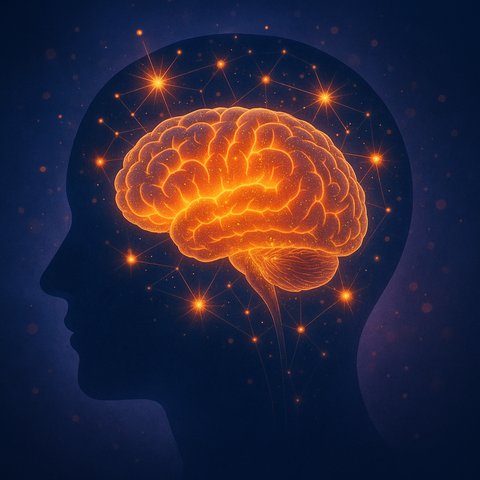 When a person laughs, it looks perfectly familiar from the outside — the lips stretch into a smile, the eyes narrow, the shoulders shake. But at that very moment, an entire concert of interactions is unfolding inside. The brain instantly responds to incongruity: something that at first seems illogical or absurd suddenly makes sense. And as soon as we “get” the joke, the nervous system releases a dose of dopamine — that familiar “pleasure hormone”.
In essence, humor is a miniature puzzle that the brain solves in a fraction of a second. It detects an inconsistency, restructures perception, and once the solution is found, a wave of laughter follows. People with a well-developed sense of humor often have quick reactions and flexible thinking: their brains are well trained to spot unexpected connections where others see only a pile of unrelated pieces.
But intelligence is only part of the story. Emotions and personal experience play a major role as well. The same joke may make one person laugh hysterically while another reacts with confusion or irritation. The brain interprets humor through the lens of its own memories and personal boundaries. If a joke touches a sensitive point, the reaction may be anything but funny — and may even become dangerous.
Interestingly, both halves of the brain take part in processing humor. The left side is associated with logic and constructing meaning — it “solves” the joke — while the right evaluates the emotional context: whether it is funny or not. Only when both sides reach agreement do we laugh. It is a relatively unusual moment in our mental life when reason and emotion work in sync.
Why, then, do some people see something funny almost everywhere while others barely see it at all? One simple explanation is that the first group has a much lower threshold of seriousness. They allow themselves to play with perception, let go of control more easily, and interpret the world through irony more often. People who remain in a state of constant inner mobilization — “I have to keep a straight face, I’m a tough guy, I’m a serious lady” — do not allow themselves to laugh. Humor requires a certain inner freedom.
And finally, humor itself comes in different forms:
- Kind humor — when we laugh together, not at someone. It brings people together and eases tension.
- Sarcastic humor — a tool of the mind and a way of creating distance: through irony, a person protects themselves from pain or awkwardness.
- Dark humor — an attempt to tame fear. When we laugh at something frightening, it can feel as though we are taking some control over it.
- Self-irony — almost a genre of its own. It is a high form of psychological maturity: being able to laugh at yourself without humiliating yourself. People who possess self-irony are less easily wounded by criticism because they often manage to say first what someone else might have used against them. And a joke works best when it gets there first.
Humor is not simply something funny. It is the work of reason and emotion, a rapid play of perception, and a way of maintaining balance in an unpredictable world full of surprises.
Sense of Humor and Personality
 We all laugh, but we do it differently. Some people hide a quiet chuckle behind their hand, others laugh loudly until tears come, while some barely lift the corners of their mouth to show that they understood the joke. These are not merely habits, but reflections of personality. Humor is a kind of mirror of the self — a remarkably honest mirror in which it is difficult to portray something that does not match reality.
Psychologists have long noted that a sense of humor is closely connected with intelligence and flexible thinking. To understand a joke, you need to switch quickly between contexts, grasp what is implied between the lines, and recognize irony. In this sense, good humor is partly an intellectual exercise. It is no coincidence that wit often accompanies intelligent people, although it can also make them rather dangerous in an argument.
But intelligence is not the most important part. The deepest layer of humor is connected with empathy — the ability to understand other people’s feelings. To make an appropriate joke, you need to sense the boundaries of the person in front of you and pick up on their mood. Someone who can do this rarely hurts others and usually inspires sympathy. There is a reason people say that a kind person tends to make kind jokes.
There is another side as well: sometimes humor becomes a shield. Vulnerability, awkwardness, or anxiety can be hidden behind it. Sarcasm and self-irony are typical examples of this kind of defense. As we mentioned earlier, when people joke about themselves, they gain some control over what might otherwise become a target for criticism. It is their way of telling the world: “I’ve already laughed at myself, so you don’t need to bother.” There is quite a lot of inner strength hidden in that.
Humor is also closely connected with self-esteem. People who feel secure in themselves allow themselves to laugh at their mistakes. They do not need to be flawless in order to feel that they have value. Those who live under the pressure of an ideal image, however, often experience jokes as a threat. For them, laughter is not joy, but a risk of losing control.
It is no coincidence that a sense of humor is considered one of the signs of psychological resilience. In a stressful situation, a person who can still smile has already relaxed to some degree and can once again manage their feelings, thoughts, and reactions. In other words, humor helps shift the mind from an emotional mode toward a more rational one. It creates a certain distance between the person and their anxiety, which can significantly help with making better decisions in difficult situations.
So a sense of humor is not merely the ability to make jokes, but also an ability to regulate yourself. It is about maturity, inner freedom, and how much at peace we are with ourselves.
It is also worth noting that if someone does not have much of a sense of humor, that is not a disaster either. Perhaps they simply have not yet developed this powerful psychological tool. All of us laughed for the first time at some point in our lives. It is something that can be learned at any age — and if you try, you may even enjoy it.
Can a Sense of Humor Be Developed?
 Some people are convinced that a sense of humor is innate, like eye color or leg length. If it is “given” to you, you laugh; if not, you are condemned to endure everyone else’s jokes. But that is not really the case. Humor is not a genetic gift, but a skill that can — and should — be developed.
The best place to start is with something simple — toobserve what is funny. The world is full of absurdity if you only look closely enough. On a bus, in a meeting, even inside your own head, something amusing is happening all the time. Humor is essentially the ability to notice a mismatch between expectation and reality. If you train this way of seeing, this instinct, you will begin to notice a huge number of funny situations around you. Not because there are suddenly more of them, but simply because you have learned to see them.
The second step is to learn to laugh at yourself. It is the safest and most honest exercise — after all, you are unlikely to start a fight with yourself. Try treating your mistakes as material for stand-up: spilled coffee, a forgotten password, mixing up the date of a meeting — there is your story. Humor does not remove responsibility in these moments, but it can make life much easier. You stop fighting a pointless war against yourself.
The third approach is to spend time with people who have a well-developed sense of humor. Laughter is contagious not only emotionally, but cognitively as well. When we listen to witty people, our brains begin to imitate their way of thinking and learn to find unexpected connections. It is like training with people who run a little faster than you — eventually you get drawn in and try not to fall behind.
There is also a more deliberate technique: consciously look for something funny in difficult situations. Not in order to laugh at someone else’s pain, but to learn to notice the absurdity of what is happening when everything goes wrong. This can serve as a form of psychological protection and inner wisdom: if you can smile, then you are no longer completely trapped by the problem and are better able to begin solving it effectively.
It can also help to read and watch humor that feels close to you. It might be light stand-up, subtle British irony, or warm family humor. The important thing is not to consume it passively, but to ask yourself: why is this funny? In this way, you gradually develop your own sense of timing, unexpected meanings, and good-natured irony.
And finally, do not confuse humor with spitefulness. A genuine sense of humor does not wound, humiliate, or place you above others. It helps preserve lightness even when everything around you is going badly. It is not a way to hide from life — it is a way to move through life’s difficulties more easily.
A sense of humor is not a luxury or merely an amusing personality trait. It is part of our psychological resilience, an inner shock absorber that protects us from excessive seriousness and helps us keep our sanity in a world full of paradoxes. When we laugh, we are not running away from reality — we are negotiating with it. Laughter creates distance, lets us look at life from another angle, and restores the lightness that anxiety and endless striving so often take away.
Humor does not make us more foolish — on the contrary, it can make us wiser and kinder. Because a person who can laugh at themselves often understands themselves more deeply, including how they themselves are put together. And that means they may also be better able to understand the people around them. So if you feel like smiling sometimes, do not hold back. It is not weakness; it is a way of surviving without losing your taste for life. And perhaps, in that very moment, you become a truly rational creature on our planet.