



Consciousness is something we talk about often, yet rarely stop to think about what exactly lies behind the concept. We live, feel, choose, make decisions, replay the past in our minds, and make plans for the future. All of this feels as natural and familiar as breathing. But the moment we ask ourselves what consciousness actually is, a kind of fog appears: it is clearly there, yet impossible to touch.
For a long time, people believed that consciousness was a uniquely human privilege. That only we could reflect, conduct inner dialogues, build abstractions, and tell stories. That only humans were capable of self-reflection — of that very “I understand that I understand”. This view remained dominant for a very long time. It emphasized our difference, our uniqueness, our supposedly “higher” nature compared with other living beings.
But the more closely we observe animals, the harder it becomes to hold on to these old ideas. We are used to thinking of consciousness as the highest level of the mind, accessible only to humans. But perhaps it is not a summit at all, but a long staircase on which different animals occupy different steps. And if that is so, then the question is no longer whether animals have consciousness or not. The question becomes what form it takes and where its boundaries lie for different species of the animal world — a world that quite reasonably includes humans as well.
Consciousness remains one of the most difficult and mysterious topics in psychology. It brings together memory, perception, emotions, choice, our relationship with the environment, our understanding of our place within it, and much more. To understand all of this is to understand how human experience is organized — and, at the same time, to stop looking at other living beings as programmed robots without an inner world.
In this article, we will try to understand what consciousness is, where the old ideas came from, why they are changing, and what current evidence tells us about animals, about ourselves, and about what we are used to calling “conscious”.
Consciousness as a Mirror of the Human Being
 When thinkers of the past tried to explain what makes a human being human, they almost always began with consciousness. In early modern philosophy, this idea became fundamental. Descartes formulated his famous phrase “Cogito, ergo sum” — “I think, therefore I am.” He saw consciousness as the point from which everything human could be built: if I am capable of becoming aware of my own thought, then I can be certain that I exist.
This understanding of consciousness was closely tied to rationality. A human being was seen as a creature capable of reasoning, making decisions, and understanding the world not only through sensation, but through reflection. Consciousness was therefore imagined as something like an inner light or mirror in which everything happening around and within us is reflected. And the ability to recognize oneself in that mirror — self-awareness — was declared the main distinction between humans and animals.
Later, psychologists of the nineteenth and twentieth centuries developed this idea in their own ways. Freud, for example, viewed consciousness as the thin tip of an iceberg beneath which lay a vast unconscious — impulses, fears, and desires. Yet even then, consciousness remained one of the central elements of the human psyche. It organizes our experience, controls behavior, helps us maintain social norms, plan our lives, and regulate emotions. The very existence of an inner observer capable of saying “I feel”, “I think”, “I want” was treated as a uniquely human ability.
This is how the classical idea gradually formed: consciousness is what allows us to see ourselves “from the outside”, evaluate our actions, analyze our thoughts, and make decisions not only instinctively but deliberately. In this picture, the human being is the only creature capable of a fully developed inner dialogue, of describing personal experience, and of building complex chains of cause and effect.
But this approach has one weak point. It assumes that other living beings cannot possess anything similar simply because they do not speak or function at the same level of complexity as humans. In essence, consciousness was long described only through the lens of human experience, as if we were the only conscious beings in the universe. This became the starting point for what many philosophers call “anthropocentrism” — the habit of judging all living things through the human perspective.
Let us examine this approach further. We will consider which parts of those older ideas have become outdated, which remain important, and why contemporary science encourages us to look at the question more broadly.
Animal Consciousness: Where Are the Boundaries?
 The more carefully we observe animals, the harder it becomes to maintain the familiar opposition in which humans are the only conscious beings while animals are treated as instinct-driven mechanisms. Over the past few decades, science has been literally rewriting our understanding of how many living creatures perceive the world around them and themselves. At some point, a new realization emerges: the familiar boundary between “reflex” and “deliberate action” begins to blur.
Take dolphins, for example. These marine mammals can pass the so-called “mirror test” — a classic experiment in which a mark is placed on an animal’s body that it can only see in a reflection. Most species simply ignore the mirror or treat the reflection as another member of their species. A dolphin, by contrast, moves closer, examines the mark, and appears to investigate what it is. Such behavior at least resembles the beginnings of self-recognition — an ability to distinguish “self” from the external world.
Crows and other corvids amaze researchers no less. They are capable of planning for the future: they cache food and choose hiding places depending on risk. More than that, a crow takes into account whether another crow saw it hide the food — and if so, it may move the cache, as though estimating the intentions of a potential “thief”. Such behavior is difficult to reduce to a simple reflex. It requires a degree of cognitive flexibility, good memory, and the ability to take another individual’s point of view into account.
Dogs also display remarkable forms of awareness, though of a somewhat different kind. They “read” human emotions, pick up nuances of voice, and respond to the context of a situation. They also show early forms of empathy: many dogs react when their owner cries or come closer when a person is upset. This is not merely a conditioned reflex — the dog has to register another person’s state and relate it to its own experience in order to respond in that particular way.
Octopuses are another fascinating case. Their nervous system is organized very differently from ours. Yet even here we encounter behavior that resembles deliberate action: octopuses solve complex mazes, open jars, hide, change color according to the situation, and can even display distinct personalities — some seem playful, some cautious, some almost “resentful”. There are documented cases of octopuses squirting water at laboratory workers they appeared to “dislike”. It is difficult to say exactly what an octopus feels, but this behavior is certainly not easy to describe as a mere chain of automatic reactions.
Modern research increasingly suggests that animals have rich inner lives. Yes, those inner worlds may not be the same as ours, and we may not yet be able to assess the differences very precisely. But that does not make them any less real for the animals themselves. We try to separate “reflex” from “reason”, only to encounter behavior that looks much more like decision-making than primitive reaction.
Perhaps the question of animal consciousness should not be framed as whether it exists or does not exist. It may be more useful to ask instead: what form does consciousness take in a particular species, and what cognitive capacities are available to it? This way of posing the question is far deeper and more interesting than the outdated contrast between “rational humans” and “irrational animals”.
Consciousness as a Spectrum Without a Clear Boundary
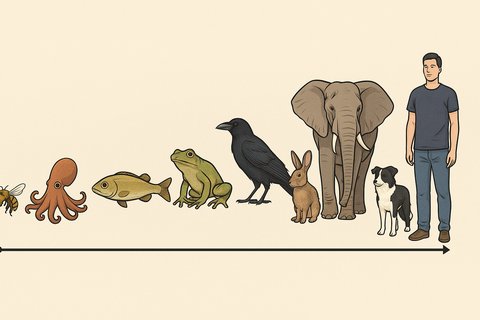 Where consciousness was once imagined as something binary — either present or absent — modern science is increasingly inclined to understand it as a spectrum. In other words, not as a boundary beyond which consciousness disappears, but as a continuous scale on which different beings occupy different levels.
Speaking of humans, it is also worth noting that our own consciousness is not the same at every moment of life. To see this, we only need to consider familiar states. Think of the sensations immediately after waking or during light sleep. Consciousness is present, but it is dim and diffuse compared with periods of active wakefulness. Consider another example: intense emotional arousal. When many of us are overwhelmed by fear or anger, or find ourselves in a critical situation, time seems to narrow to a single impulse and the ability to think clearly may drop sharply. In others, by contrast, assessment of the situation and speed of thought can increase so dramatically that afterwards it is hard to explain the reaction that helped them avoid danger.
These are simple and familiar examples, but they clearly show that consciousness has levels and degrees. It is not fixed: it can expand or narrow, “fade” or “flare up”. And if human consciousness behaves this flexibly, it is reasonable to assume that animal consciousness may also exist in different gradations.
Research into the relationship between brain and body has made an important contribution to this understanding of consciousness as a spectrum. Consciousness is not only about neurons. It also includes the way the body responds to the world: how we experience pressure, pain, warmth, taste, fear, and safety. It is impossible to separate the brain from physiology and say: “Consciousness begins here and ends there.” These processes form one complex system in which emotions, sensations, and thoughts are tightly intertwined.
Today, science often prefers to speak about different levels of consciousness. Let us try to outline them:
- Basic level — the ability to feel pain, respond to threats, and distinguish pleasant from unpleasant.
- Intermediate level — understanding regularities, the ability to learn, remember, and make choices based on experience.
- Higher level — the ability to analyze one’s own thoughts, reflect on the future, and build complex models of reality.
Humans can, of course, be placed near the top of this spectrum because of our capacity for abstraction and self-reflection. But the scale itself is highly generalized. We are not alone on it: animals are there as well, each at its own level. It makes more sense to discuss the relative position of humans and other animals on this scale than to ask who has consciousness and who does not. In other words, the questions should now be framed differently: at what level does consciousness operate in a given being, how does it manifest itself, and what kinds of tasks can it solve?
This approach makes our picture of the world far richer and more interesting. We stop dividing life into “intelligent” and “non-intelligent” and begin to see how diverse the inner worlds of living beings can be. Thinking of consciousness as a spectrum shifts our psychological focus: from our own exceptionalism toward interaction with nature, from rigid hierarchy toward a better understanding of the world around us. In the long run, this can significantly deepen our process of discovery and become a powerful evolutionary tool.
Machines, Plants, and Ourselves
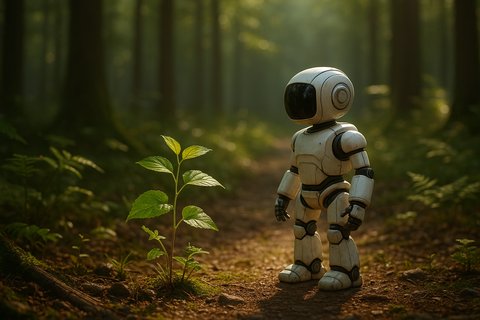 When we talk about consciousness, we almost automatically think of humans and animals. But in recent decades, two other major topics have entered the discussion: plant consciousness and artificial intelligence. Each of them, in its own way, pushes us to reconsider what we mean by consciousness.
Let us begin with plants. They do not have brains, nervous systems, or sense organs in the way we usually understand them. Yet this does not prevent them from responding to the environment with remarkable sensitivity. They distinguish light from shade, moisture from drought, change the direction of their growth, and warn one another about pests through chemical signals. In some species, root systems distribute resources among neighboring plants almost as if they were members of a single community. It is still difficult to call all of this consciousness in the human sense, but reducing it to the word “mechanism” also seems insufficient. More likely, we are dealing with another form of sensitivity — unlike our own, but highly effective in its own way.
Now let us turn briefly to artificial intelligence (AI). This is, of course, not a biological system, but a set of algorithms capable of learning from enormous amounts of data. Yet as soon as we see a program respond, reason, play, or create, a natural question arises: can we regard such behavior as even a rudimentary form of consciousness? Perhaps something vaguely comparable to early forms of consciousness in childhood? And how far might AI develop in the future as its algorithms improve, in a way that loosely parallels how humans learn and develop across life? The answer is far from simple. On the one hand, AI has no subjective experience — no inner “self” that feels pain, joy, or fear (at least, not as far as we know today). Remember the Terminator’s line in one of the films from the famous Hollywood franchise: “I don’t feel pain. I register damage.” On the other hand, AI increasingly demonstrates complex forms of adaptive behavior, which once again forces us to ask: what exactly makes consciousness consciousness?
We are used to thinking of consciousness as purely inner self-experience. But AI reminds us that intelligence can exist without subjective experience. Plants remind us that sensitivity to the world can exist without a brain or a developed nervous system. Animals, meanwhile, show us that an inner world can be complex and rich without the need for human language or human-style logic.
Each of these examples seems to turn the mirror back toward us. What do we actually mean by consciousness: the ability to recognize oneself? To choose? To anticipate the future? To interact? To experience emotions? Perhaps our understanding is too tightly bound to the human model, and perhaps we simply lack the knowledge needed to describe other forms of it.
Even now, however, one conclusion suggests itself. Consciousness is not a simple switch that turns on only in humans. It may be more like a flame that can burn brighter or dimmer, remain quiet or vivid, diffuse or focused. It helps us not merely to exist, but to understand that we are living beings in this complex world.
It is also worth noting that the ability to recognize something of ourselves in others — in animals, plants, and even machines — places us on a particularly reflective rung of this ladder. When we see that the world around us is not as primitive and mechanical as it seemed until quite recently in historical terms, we begin to look differently at ourselves, at what is right and wrong, and at what we should do to preserve the world we live in rather than lose it while possessing the powerful capabilities we have today.