



Sometimes it can feel as if we all live at different speeds. Some people are perfectly comfortable spending the whole day around others, constantly discussing things, arguing about something, and joking without a break. In the evening they may want to go to a bar, a club, or simply head outside to “get some air”. Others, after just a couple of hours of socializing, long for silence, solitude, and the feeling that everyone has finally forgotten about them and left them alone. At some point, any of us may begin to reproach someone who is wired differently for being somehow “abnormal”.
In situations like these, the labels “introvert” and “extrovert” often come to mind. Sometimes they are used together with certain stereotypes. An introvert is assumed to be withdrawn and completely absorbed in themselves. An extrovert is assumed to be superficial, unable to focus or act effectively. One person is “too quiet”, another “too talkative”. These labels quickly turn into explanations for communication problems, misunderstanding, and irritation, even though reality is much more complicated.
The problem is that we tend to interpret a person’s behavior first and foremost as an attitude toward other people and toward us personally. Silence may look like coldness or indifference, activity like pressure or manipulation, and the desire to be alone like contempt for others. This can lead to unnecessary hurt and conflict. In the “wrong” social circle, it is easy to start feeling like an outsider.
This article is not about which people are better or worse. Nor is it about reshaping ourselves to suit those around us and fit into a group. It is about why we feel more comfortable in some situations and less comfortable in others. And it is also about how these differences can create unnecessary conflicts where we might instead try to understand one another and make relationships with loved ones, friends, or colleagues more comfortable...
It’s not about character, but about a way of life
 When we talk about introverts and extroverts, we often reduce the difference to the idea that the former are less sociable and the latter more so. At first glance, it seems simple: some people enjoy company and endless conversations, while others value silence and solitude. But this explanation is too simplistic and not entirely accurate. Introversion and extroversion are not about liking or disliking people, and not simply about being talkative or withdrawn. They concern something more fundamental — how a person recovers after activity and restores inner balance.
Put simply, introverts and extroverts react differently to the outside world in terms of stimulation and load. For some people, external stimuli — conversations, events, interaction — provide extra energy. They help them collect themselves, clarify their thoughts, and feel alive and engaged. Extroverts draw energy from this stimulation. For others, the same external flow is tiring. Introverts need some time without contact, conversation, or the need to respond in order to return to a comfortable psychological state. This is not a choice made at some point in life and not a habit acquired later, but a feature of psychological self-regulation that differs from person to person.
From the outside, introverts may appear closed off, cold, or socially awkward. That is not necessarily true at all. An introvert can be highly sensitive, attentive to others, and perfectly comfortable navigating social situations. But after a certain amount of activity, they need a pause to recover.
Conversely, someone may assume that extroverts are superficial people who constantly need attention. That is just as misleading. An extrovert can be thoughtful, deep, and serious. But they may be wired in such a way that contact with other people gives them the energy they need to feel focused and recharged.
So it is more useful to talk not about fixed “types of people”, but about different styles of living. One person feels better when there is movement, exchange of information, and regular contact with the outside world. Another seeks quiet, predictability, and time alone. These differences affect not only communication, but also work, rest, decision-making, and reactions to stress. In the same circumstances, different people can feel completely different precisely because they restore spent energy in different ways.
This is where confusion and even negative judgments often arise. We tend to evaluate people by visible behavior and quickly draw conclusions about their character, intentions, or attitude toward us. But introversion and extroversion say nothing about values, moral qualities, or maturity. They simply describe the conditions in which a person finds it easier to maintain psychological balance. Once we understand this clearly, it becomes much easier to see not a “difficult” or “inconvenient” person beside us, but simply someone with a different rhythm of life.
Why it can be difficult to understand each other
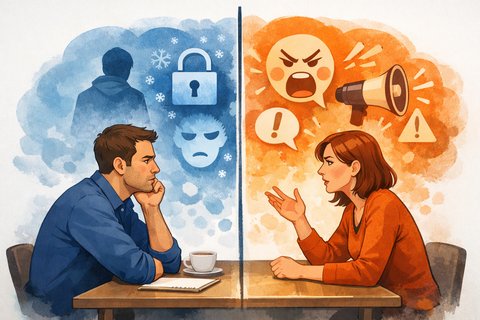 In everyday life, we rarely think consciously about behavioral differences. We encounter particular people in particular situations, and the people we talk to may be in all kinds of moods at that moment. This is where the first communication difficulties appear. We do not simply observe another person’s behavior; we try to understand it, explain it, and fit it into our own picture of what is happening. We do this so quickly that we rarely notice the background process, even though it is far from simple.
We are used to looking for meaning in other people’s actions. It matters to us not only to understand what is happening, but also to assess what place we ourselves occupy in it. So any behavior that feels unusual from our point of view starts to look like a signal. We do not merely register a sequence of events; we turn them into messages: what does this person feel, what do they want, how do they feel about us? And the more important the person or situation is to us, the more actively this mechanism begins to work.
It is easy to make a mistake when another person’s behavior does not match our expectations. We may be ready for a conversation and receive silence or withdrawal instead. Or, on the contrary, we may desperately want peace and quiet but encounter active contact and no chance to get the rest we need. In such moments, of course, we do not calmly think in scientific terms that the other person may simply be introverted or extroverted and that this is their usual way of responding. Under the influence of emotion, we are more likely to feel discomfort and immediately try to explain it.
That quick explanation is almost always highly subjective. If someone goes silent, we may feel that their silence is directed specifically at us. If they actively seek contact, we may feel that our boundaries are being crossed and pressure is being applied. We begin to feel either rejected or trapped. Even when we understand rationally that people are simply different, emotions often take over in real interaction.
In other words, we usually read other people’s behavior through our own experience — through the way we ourselves react in similar situations. If silence means tension or resentment to us, we become wary even when the other person’s reasons are completely different. If activity is our way of building contact and gaining energy, we may overlook the fact that for someone else the same activity drains energy and creates overload. Our own interpretation feels natural and obvious simply because, from our point of view, it is perfectly logical.
Over time, these situations repeat and a certain negativity can accumulate in the relationship. One episode can be dismissed as chance, but a chain of similar events gradually forms a stable image of the other person. They become “cold”, “selfish”, “pushy”, or “manipulative”. Yet, as already noted, this may not be true at all. The image may simply have been built from our own conclusions and expectations.
This interpretive process almost never feels like our own mistake. We do not think that we are filling in gaps or distorting reality. On the contrary, we are convinced that we have seen everything clearly and understood it correctly. It can be very difficult to stop and ask ourselves: “Could there be another explanation for this person’s behavior?” As a result, we may end up reacting not to the real person in front of us, but to an image we have created ourselves.
This is how differences stop being neutral and begin to feel like a source of tension. Eventually, such a situation can even threaten a relationship. People may live together, communicate, or work on the same project and still feel growing misunderstanding and distance. Not because one of them is bad, but because the interaction is taking place with an imagined image rather than with the real person opposite them.
To sum up, the problem is not the differences themselves, but how easily and almost invisibly we begin to misinterpret what is happening. As long as this mechanism remains emotional and unconscious, it will keep creating tension in communication — even though it is something we can learn to notice and avoid.
Typical everyday situations
 If we look at familiar everyday situations through the ideas discussed above, many conflicts can be stopped before they really begin. Let us consider a few scenes that many of us have probably encountered more than once. Think of this as a small mental exercise. We will not try to prescribe the “correct” way to act in each case. Instead, try to imagine yourself in the situation and decide whether it is worth reacting emotionally as usual, or whether it might make sense to understand both the situation and the other person and respond differently.
An evening at home
The evening comes after a difficult day at work. One partner has been looking forward to it as a chance to finally be together, talk, discuss the day, and share thoughts and emotions. For them, this is an important moment of closeness and recovery. The other partner, however, feels that they need some quiet in order to recover. They are physically present, but need an emotional pause. Try to put yourself in the position of whichever person feels more understandable and “right” to you, and then think about how you might act without hurting the other. Perhaps you would simply explain that you are exhausted, or perhaps you would soften your own needs for a while in order not to hurt the other person. The ultimate goal is not to wound someone or damage the relationship. The choice is yours.
A day off
One person is looking forward to rest, no plans, and the chance to stay comfortably at home. The other wakes up full of ideas: a trip, meetings, errands, new impressions. Try to notice what feels most unfair in this situation — the other person’s behavior, or simply the fact that your expectations did not match.
A holiday together
One person wants a packed holiday schedule with excursions, walks, and constant activity. The other would prefer a slower pace, fewer plans, and more time at the beach or hotel. Put yourself in both positions and think about the moment when a holiday stops feeling like rest and misunderstanding begins.
A family dinner or celebration
Someone talks actively, jokes all the time, and keeps drawing everyone else into the conversation. Another person mostly listens and barely joins in. Think about what each of them might be thinking in this situation and how they might interpret the behavior of the other.
A work meeting
One employee speaks frequently, reacts immediately to colleagues’ ideas, and proposes different solutions. Another prefers to think things through first and speaks much less. Try to imagine how each of them evaluates what is happening.
Messaging
One person writes quickly and at length, expecting equally quick replies. The other responds briefly and with pauses. Is the first being ignored? Is the second being pressured? What conclusions might each person draw? What would you do?
Preparing for an important event
One person wants to discuss everything in advance, go over all the details, share their anxiety, and talk through what might happen. The other prefers to prepare in silence, focus inwardly, and avoid unnecessary discussion. Try to put yourself in both positions and consider whether one person needs support and whether the other is simply avoiding extra pressure that would interfere with their preparation.
After a difficult conversation or conflict
One person wants to return to the subject immediately and discuss what happened in order to clear everything up. The other wants a pause and prefers to postpone the conversation in order to reduce the risk of escalating the conflict and think through what to do next. Is the first person really applying too much pressure, and is the second really avoiding an important conversation?
Travelling together
You are driving somewhere, taking a train, or flying. One person wants to talk, discuss plans, and share thoughts. The other prefers silence and perhaps a short nap. Try to imagine what emotions may gradually build up for each of them during the journey.
Try to continue each of these scenes in your imagination in a way that feels appropriate for you and for the people you live, work, or communicate with. There is no need to follow universal rules or search for the scientifically “correct” answer. Try instead to feel what each person may be experiencing, taking into account the context, the relationship, and what is genuinely important for you to preserve rather than lose.
How do we live with these differences?
 Many things gradually stop looking so dramatic once we understand the reasons behind them. Communication difficulties do not disappear completely, of course, but our view of the situation changes and we gain the possibility of adapting to these differences. Other people’s behavior no longer feels like something directed personally against us. We begin to see it simply as an expression of their current state, their comfortable rhythm, and their way of existing in the world.
At this point, there may be a temptation to urgently fix something: ourselves, the other person, or the relationship as a whole. But there is no need to rush into reshaping either ourselves or the people around us. Different ways of reacting to fatigue, closeness, and contact are not a glitch in the “matrix” that must be corrected, but part of human nature and human diversity. The more we try to make everyone the same, the more tension we are likely to create in relationships.
It is worth recognizing that many conflicts are sustained not by differences themselves, but by our belief that there is one “normal” way to behave in society. As soon as someone steps outside that framework, irritation appears along with the desire to explain how they should behave “properly”. But universal rules work poorly in real life. People do not live according to an instruction manual, no matter how much we might wish they did.
Life becomes easier when we allow differences to exist. We do not have to justify them, constantly explain ourselves to everyone, or turn them into a reason for argument. Often it is enough simply to say that we need a pause or some time alone, or, on the contrary, to ask for help, talk something through, and make a difficult decision together. There is no need for accusations, demands, or attempts to prove that we are right. It may not work perfectly at first, and that is natural too. Even small attempts to agree on rhythm and necessary boundaries can noticeably reduce the number of tense situations.
It is also important to remember that being understood matters greatly, but learning to understand others matters just as much. This will not guarantee a complete absence of conflict, but it can make conflicts less frequent and less destructive. Instead of seeing someone beside us as “difficult” or “inconvenient”, we can begin to see a real person with their own characteristics and limitations.
That is the main conclusion of everything discussed above. We do not have to match one another in rhythm, needs, or ways of interacting in order to remain close, work together, or simply coexist peacefully. It is enough to recognize that differences are neither a natural defect nor a threat to every relationship. Sometimes this is simply life — a life in which each of us gains invaluable experience and learns to remain ourselves beside people who may be very different from us.